
15CA and 15CB Filing Guide: Foreign Remittance Reporting, and the Forms That Replaced Them
The remitter's paperwork journey for a payment to a non-resident — which part of the form you file, when an accountant's certificate is required, why the bank will not release the money without it, and what Forms No. 145 and 146 changed on 1 April 2026.
On this page
- Quick answer
- The date that decides which forms you file
- The old-to-new form map, and what it is not
- When 15CB is required
- What the accountant is actually certifying
- What to hand the accountant
- The parts of 15CA
- When nothing at all is required — Rule 220(3)
- Where DTAA comes in
- The lower-deduction route: section 395 and Form No. 128
- Why your bank insists
- Worked examples
- 1. A ₹3,00,000 software subscription — Part A and nothing else
- 2. A ₹40,00,000 royalty — the accountant's certificate route
- 3. An individual's remittance where nothing is filed
- Common mistakes
- After remittance
- What it costs to get this wrong
- What this page does not claim
- Sources and currency
Paying a foreign vendor, sending royalty abroad, settling an intra-group invoice in dollars — there is a compliance step before the bank will let the money go. This page is the remitter's side of it: which form, which part, who signs what, and what happens after the payment clears. The law deciding how much to deduct is in section 393(2) of the Income-tax Act, 2025, covered in our guide to TDS on payments to non-residents.
Quick answer
Form 15CA is the remitter's declaration for a foreign remittance; Form 15CB is a chartered accountant's certificate on the remittance's taxability and the tax to be deducted. Many taxable remittances need both before the bank processes them.
For a remittance made on or after 1 April 2026, those are no longer the forms you file. Rule 220 of the Income-tax Rules, 2026 puts the declaration in Form No. 145 — Parts A to D — and the accountant's certificate in Form No. 146. A remittance made up to 31 March 2026 stays on Forms 15CA and 15CB. The number deciding whether the certificate is needed at all is ₹5,00,000: the payment, or the aggregate of payments, in the tax year.
The date that decides which forms you file
The Income-tax Act, 2025 came into force on 1 April 2026 — section 1(3), not section 1(2), which is only the extent clause. The Income-tax Rules, 2026, notified as G.S.R. 198(E) dated 20 March 2026, came into force the same day.
Get one thing straight first, because most wrong answers here start with it: assessment year 2026-27 is financial year 2025-26, and it is still governed by the Income-tax Act, 1961. The 2025 Act governs tax year 2026-27, which is financial year 2026-27. The Finance Act, 2026 proves it in one enactment — section 2(1) charges tax for the assessment year commencing 1 April 2026 under the 1961 Act, section 3(1) for the tax year commencing 1 April 2026 under the 2025 Act — and section 536 repeals the 1961 Act while keeping it alive for earlier tax years.
For your remittance file, that resolves to one line:
| When the remittance is made | Declaration | Accountant's certificate | Rulebook |
|---|---|---|---|
| Up to 31 March 2026 | Form 15CA | Form 15CB | Income-tax Act, 1961 and the rules under it |
| On or after 1 April 2026 | Form No. 145, Parts A to D | Form No. 146 | Rule 220, Income-tax Rules, 2026 |
One honest caveat on the straddle. The deduction behind the remittance is timed by the earlier of credit or payment — section 393(2)(b) — so a sum credited in March 2026 and remitted in May 2026 is an old-Act deduction even though the money moved under the new Rules, and the Rules spell out no transitional rule for that split. Where credit and payment fall on opposite sides of 31 March 2026, settle it with your accountant and your bank.
The old-to-new form map, and what it is not
| Familiar label | What it does | Now | Prescribed by |
|---|---|---|---|
| 15CA | Remitter's declaration | Form No. 145 (Parts A–D) | Rule 220 |
| 15CB | Accountant's certificate on taxability and deduction | Form No. 146 | Rule 220 |
| 10F | Payee's information supporting agreement relief | Form No. 41 | Rule 75, under section 159(8)(b) |
| 27Q | Quarterly statement, non-resident deductee | Form No. 144 | Rule 219(1), serial number 2 |
| 16A | Deduction certificate given to the payee | Form No. 131 | Rule 215(1), serial number 2 |
This mapping is MyFinancialAdvisory's derivation from what each form does. The Central Board of Direct Taxes has published no concordance, and any page presenting one as official is overstating it. The new form numbers are cited to the Rules; the old labels are only for bearings.
When 15CB is required
Broadly, when a taxable foreign remittance exceeds the prescribed threshold, a certificate is required alongside the declaration. Below it, or for certain exempt or specified payments, only part of the declaration — or nothing — applies. The requirement depends on the amount and nature of the remittance.
Under Rule 220 the threshold has a number: ₹5,00,000, measured on the payment, or the aggregate of payments, in the tax year. Two consequences follow.
- A monthly remittance of ₹60,000 to one vendor is under the threshold in month one and over it by month nine. The certificate obligation arrives partway through the year, not at a single invoice.
- Whether that aggregate is read per payee or across every non-resident payee is not spelled out in the rule as published, and we do not assert an answer. The reading that costs nothing if wrong is to track the running total and line the certificate up as it approaches ₹5,00,000.
The certificate is given by an accountant as defined in section 515(3)(b) of the Income-tax Act, 2025.
What the accountant is actually certifying
Not whether the payment is commercially sensible. The certificate addresses whether the sum is chargeable under the Act, and if it is, the tax to be deducted.
Behind that sits section 393(2), which governs deduction from sums paid to a non-resident. Keep the sub-sections apart: 393(1) is payments to a resident, 393(2) a non-resident, 393(3) any person; salary is section 392 and collection at source is section 394. Most business remittances land on Table serial number 17 of section 393(2) — "any interest … or any other sum chargeable under this Act, not being income chargeable under the head 'Salaries'" — the successor to section 195 of the 1961 Act. Its rate is "rates in force", and this page puts no number on that.
What to hand the accountant
Assemble this once and the certificate is a day's work, not a fortnight's chase:
- The invoice and the agreement the payment is made under.
- The nature of the payment — licence, service, royalty, interest, reimbursement, consideration for an asset.
- The payee's name, address and country of residence, and its PAN if it has one.
- The payee's certificate of residence and Form No. 41, where agreement relief is claimed.
- A schedule of prior remittances in the same tax year, so the ₹5,00,000 aggregate is computed, not guessed.
- Any certificate or order under section 395 already obtained.
- The Reserve Bank purpose code your bank will use, and the authorised dealer's checklist.
If the payee has no PAN, Rule 217 can still keep you off the higher rate in section 397(2)(b)(i) — but only against four items from the payee, and only for a closed list of payment types: interest, royalty, fees for technical services, dividend, and payments on transfer of any capital asset. Outside that list, no relief; the four items are set out in our non-resident TDS guide.
The parts of 15CA
The declaration has four parts, and which one you file turns on whether tax is deductible, on the amount, and on what certificate you hold. Choosing wrongly is a common error. Rule 220 sorts it:
| Situation | What you furnish |
|---|---|
| Payment, or aggregate of payments, in the tax year does not exceed ₹5,00,000 | Part A of Form No. 145 |
| Exceeds ₹5,00,000 and a certificate or order has been obtained from the Assessing Officer under section 395(1) or (2) | Part B of Form No. 145 |
| Exceeds ₹5,00,000 and a certificate from an accountant as defined in section 515(3)(b) is obtained | That certificate in Form No. 146, plus Part C of Form No. 145 — but where Part B has been furnished, Part C is not required |
| Sum not chargeable under the Act | Part D of Form No. 145 |
Two things about that table are worth saying out loud. Chargeability comes first — a sum that is not chargeable goes to Part D whatever its size, unless Rule 220(3) takes you out of reporting altogether. And above ₹5,00,000, Part B and Part C are alternatives, not a sequence: an Assessing Officer's certificate means the officer has already fixed the deduction, which is why Part C is not required once Part B is furnished.
When nothing at all is required — Rule 220(3)
Rule 220(3) requires no information for a sum not chargeable under the Act in three cases:
- The remittance is made by an individual and needs no prior Reserve Bank approval under section 5 of FEMA, 1999 read with Schedule III to the Foreign Exchange (Current Account Transaction) Rules, 2000.
- The remittance is by a Unit of an International Financial Services Centre referred to in section 147(1)(b).
- The remittance is of a nature in the rule's specified list of Reserve Bank purpose codes.
The third is the one people quote at each other across a bank counter. The list runs to dozens of codes; what follows is a representative subset, not the complete list, and a code's absence here is no evidence it sits outside the exemption:
- S0001–S0005 and S0011 — Indian investment abroad and loans to non-residents
- S0101–S0104 and S0190 — imports and advance payment against imports
- S0202, S0208, S0212 — operating expenses and passages of Indian shipping and airline companies abroad
- S0301–S0305 — business travel, basic travel quota, pilgrimage, medical treatment and education
- S0401 postal services, and S0501 construction of projects abroad
Check the code against the rule before relying on it, and note the condition all three cases share: each is available only where the sum is not chargeable. None is an exit from reporting a chargeable remittance.
Where DTAA comes in
If a Double Taxation Avoidance Agreement applies, it can reduce or remove Indian tax on the remittance, and the accountant's certificate reflects that. The mechanism is section 159:
- Section 159(4) — where an agreement under section 159(1), or with a specified association under section 159(2), applies to an assessee, the Act applies "to the extent they are more beneficial to that assessee". Successor to sections 90(2) and 90A(2) of the 1961 Act.
- Section 159(8) — relief is available "only when" the non-resident obtains a certificate of residence from the government of that country or specified territory and provides such other documents and information as may be prescribed. Both limbs.
- Rule 75 prescribes the second limb: the documents and information under section 159(8)(b) are "as per Form No. 41" — the successor to Form 10F.
- Section 159(6) — the anti-avoidance chapter, Chapter XI, applies even where it is not beneficial to the assessee. And where there is no agreement, section 160 gives unilateral relief at the lower of the Indian or the foreign rate on the doubly taxed income.
We state no rate under any agreement, for any country. No treaty text was captured in our verification, and a number copied off a summary table is what ends up in a certificate and then in an assessment. Name the mechanism, then read the agreement itself or take advice on it. What this page can tell you is procedural and firm: unless the residence certificate and Form No. 41 are on file before you deduct, section 159(8) is not satisfied and the relief is not available.
The lower-deduction route: section 395 and Form No. 128
Where deduction at the ordinary rate would take more than the payee's real Indian liability, the answer is not to under-deduct and hope. It is a section 395 certificate.
The application is made in Form No. 128 under Rule 213, for a certificate under section 395(1) — lower or nil deduction — or under section 395(3) for lower collection. Rule 213(3) sets out what the Assessing Officer weighs: tax payable on estimated income for the year; tax paid or payable on the returned, assessed or estimated income of the last four tax years; existing liability under the 2025 Act and under the 1961 Act as it stood before repeal; and advance tax and deducted tax already to the taxpayer's credit. A specified entity under section 263(9)(c) or a registered non-profit has further conditions under Rule 213(4).
Hold that certificate and the remittance moves to the Part B route, with no accountant's certificate needed. Note the limit of what we assert: Rule 213 names Form No. 128 for an application under section 395(1) and (3). Rule 220's Part B route also recognises an order under section 395(2); we name no form for that, because the rule does not.
Why your bank insists
Banks acting as authorised dealers must satisfy themselves about the tax treatment of a foreign remittance before releasing it, so they typically will not process a taxable remittance without the applicable declaration and, where required, the certificate. Getting them ready in advance keeps your payment on schedule. Two things are worth being clear-eyed about.
The obligation is yours, not the bank's. The checklist is a gate, not a legal opinion. A remittance the bank waves through is not thereby correctly reported: the ₹1,00,000 penalty in section 462, for failing to furnish the section 397(3)(d) information on a payment to a non-resident, falls on the person responsible for paying. A bank asking for a certificate you do not need under Rule 220 is applying internal policy, and the answer is the rule, quoted.
Two calendars have to line up. The authorised dealer's paperwork window is negotiable; the deposit deadline is not. Under Rule 218(2), tax deducted on a credit or payment in March goes to the Government by 30 April, and in any other month within 7 days from the end of that month. A remittance stuck at the counter does not stop that clock.
Worked examples
1. A ₹3,00,000 software subscription — Part A and nothing else
Assumptions: an Indian private limited company pays ₹3,00,000 in July 2026 for an annual software subscription to a foreign company; it is the company's only remittance to a non-resident in tax year 2026-27; the sum is chargeable under the Act; the payee has furnished a residence certificate and Form No. 41; no section 395 certificate has been obtained.
- Which rulebook. Payment in July 2026, so the Income-tax Rules, 2026 govern: Form No. 145, not 15CA.
- Which part. Payment and aggregate for the tax year are both at or below ₹5,00,000, so Part A of Form No. 145 is the whole reporting obligation. No Form No. 146, no accountant's certificate.
- The deduction behind it. Section 393(2), Table serial number 17, at rates in force, read with section 159(4) where the agreement is more beneficial. This page does not give you that number.
- The trap. Part A was right on the day. Remit a further ₹2,50,000 to the same vendor in December and the aggregate passes ₹5,00,000 — from then the certificate route applies. Part A is a position at a moment, not a status for the year.
- After the money leaves. Deposit within 7 days from the end of July 2026; report in Form No. 144 for the quarter ended 30 September 2026, due 31 October 2026; issue Form No. 131 within 15 days of that.
2. A ₹40,00,000 royalty — the accountant's certificate route
Assumptions: an Indian company pays ₹40,00,000 of royalty in November 2026 to a foreign company under a licence agreement; the sum is chargeable under the Act; no section 395 certificate or order has been obtained; the payee has furnished a residence certificate from its government and Form No. 41, and has no PAN.
- Which part. Above ₹5,00,000 with no section 395 certificate: the accountant's certificate in Form No. 146 plus Part C of Form No. 145, signed by an accountant as defined in section 515(3)(b). With a section 395 certificate it would have been Part B, and Part C not required.
- No PAN. Royalty is inside the Rule 217 closed list, so the four items preserve the ordinary rate instead of the higher rate under section 397(2)(b)(i). Outside that list, they would not.
- Agreement relief. Available only because both limbs of section 159(8) are satisfied before deduction. The rate is not stated here.
- After the money leaves. Deposit within 7 days from the end of November 2026; report in Form No. 144 for the quarter ended 31 December 2026, due 31 January 2027; issue Form No. 131 within 15 days of that date.
3. An individual's remittance where nothing is filed
Assumptions: a resident individual remits ₹18,00,000 for a child's university fees abroad; the purpose falls in the S0301–S0305 band of Reserve Bank purpose codes; no prior Reserve Bank approval is needed under section 5 of FEMA, 1999 read with Schedule III to the Foreign Exchange (Current Account Transaction) Rules, 2000; the sum is not chargeable under the Income-tax Act, 2025.
Nothing is filed. Rule 220(3) requires no information at all — the individual limb and the purpose-code limb each reach this remittance independently. It rests on the sum being not chargeable: the load-bearing condition and the one to document, because size is not what takes a remittance out of reporting. Were it chargeable, the exemption falls away and ₹18,00,000 puts you on the certificate route.
Common mistakes
- Remitting without the required forms. The bank rejects it and the payment slips a cycle — the most common failure and the most avoidable.
- Getting the deduction wrong, or missing an agreement benefit you were entitled to. Both cost money, in opposite directions, and both are settled before the remittance.
- Choosing the wrong part. Part D is for a sum that is not chargeable. Using it for a chargeable sum because the amount felt small is not a small error.
- Not keeping the invoice or agreement on file. The certificate rests on documents; one whose file cannot be produced later is worth far less than it cost.
- Reading the ₹5,00,000 threshold as per payment. It is the payment or the aggregate in the tax year.
- Using Forms 15CA and 15CB for a remittance made on or after 1 April 2026. Rule 220 prescribes Form No. 145 and Form No. 146.
- Treating assessment year 2026-27 as a new-Act year. It is financial year 2025-26 and stays on the Income-tax Act, 1961.
- Claiming agreement relief on an invoice footer. Section 159(8) needs the residence certificate and Form No. 41, both before deduction.
- Treating the bank's sign-off as the end of it. It is the middle.
After remittance
Where tax is deducted, compliance does not end at the bank. It used to be said as "report it in the 27Q"; under the Income-tax Rules, 2026 there are three steps, each with its own form and clock.
| Step | Rule | Form | Timing |
|---|---|---|---|
| Deposit the tax | Rule 218(2) | Challan | Credit or payment in March: by 30 April. Any other month: within 7 days from the end of that month |
| Quarterly statement, non-resident deductee | Rule 219(1), serial number 2 | Form No. 144 | 31 July, 31 October and 31 January of the financial year; for the quarter ending 31 March, 31 May of the financial year immediately following the tax year (Rule 219(4)) |
| Deduction certificate to the payee | Rule 215(1), serial number 2 | Form No. 131 | Within 15 days from the Rule 219 statement due date |
Form No. 144 covers sections 392(7), 393(2) and 393(3) where the deductee is a non-resident not being a company, a foreign company, or a resident but not ordinarily resident. It sits where 27Q sat, and Form No. 131 where 16A sat — again our derivation, not an official mapping.
Two operational details. Rule 215 certificates are generated from the portal specified by the Director General of Income-tax (Systems) — Rule 215(1), and Rule 215(7) read with Rule 332 — not typed up by the deductor. And where more was paid to the Central Government than was due, a deductor's refund claim under Chapter XIX-B is made in Form No. 139 under Rule 219(6).
The mechanics across all four statement forms are in our guide to the Income-tax Rules, 2026 TDS forms and our TDS return filing guide; the section 393 crosswalk translates old citations.
What it costs to get this wrong
| Failure | Provision | Consequence |
|---|---|---|
| Failure to furnish the section 397(3)(d) information on a payment to a non-resident | s.462 | ₹1,00,000 |
| Did not deduct, or deducted and did not pay | s.398(1) | Deemed an assessee in default |
| Interest | s.398(3)(a) | 1% a month or part month from the date tax was deductible to the date deducted; 1.5% a month or part month from deduction to payment |
| Expenditure disallowed — non-resident payee | s.35(b)(ii) | 100% of the sum, against 30% under s.35(b)(i) for a resident payee |
A late Form No. 144 carries its own fee under section 427 and penalty under section 461 on top. But the last row is why a cross-border payment is the wrong place to be approximately right: disallowance of the whole expense dwarfs the cost of the certificate that would have prevented it.
What this page does not claim
Five absences, each deliberate, each because we could not verify the item from primary text.
- Any rate under any Double Taxation Avoidance Agreement, for any country. No agreement was captured in our verification. We name the mechanism in section 159 and Rule 75 and stop there.
- Any non-resident "rates in force" figure, and any surcharge or cess loading on a non-resident deduction. That turns on Part II of the First Schedule to the Finance Act, 2026 read with section 159, and surcharge and cess behave differently here than on a resident deduction. Settle the amount with an adviser who has read your agreement.
- The reporting form for a purchase of immovable property from a non-resident by a person who, from 1 October 2026, needs no TAN. That deduction sits under section 393(2), and the challan-cum-statement rules — Rules 218(3) and 219(5) — cover only section 393(1) rows. We name no form for it.
- Whether the ₹5,00,000 aggregate is read per payee or across all non-resident payees. The rule says "the payment, or the aggregate of payments"; it does not settle the unit, and neither do we.
- That the old-to-new form mapping is official. It is our derivation; the Central Board of Direct Taxes has published no concordance table.
If your remittance turns on any of the first three, that is a conversation about your counterparty and your agreement, not a number to lift off a page. We can take the knowable parts off your desk — foreign remittance certification, quarterly TDS statements, TAN registration and income tax return filing. Get the remittance file right — the right part, the right certificate, the deposit, the statement and the payee's certificate — and your cross-border payments stay compliant and unblocked.
Sources and currency
Applies to: Remittances to a non-resident not being a company, or to a foreign company, made on or after 1 April 2026 — tax year 2026-27 onward, under the Income-tax Act, 2025 and the Income-tax Rules, 2026. A remittance made up to 31 March 2026 stays on Forms 15CA and 15CB under the Income-tax Act, 1961, and assessment year 2026-27 (financial year 2025-26) is still an Income-tax Act, 1961 year.
Every form number, rule reference and figure on this page was read from the Gazette of India text of the Income-tax Rules, 2026 (G.S.R. 198(E) dated 20 March 2026) and of the Income-tax Act, 2025, on 20 August 2026. The old-to-new form mapping — 15CA to Form No. 145, 15CB to Form No. 146 — is MyFinancialAdvisory's derivation from what each form does; the Central Board of Direct Taxes has published no concordance. No treaty rate for any country, no non-resident rates-in-force figure and no surcharge or cess loading appears anywhere on this page, because none of them was verified from primary text. Income-tax provisions change at each Finance Act; confirm the current position before relying on a figure for a filing.
- Income-tax Rules, 2026 — G.S.R. 198(E) dated 20 March 2026, Gazette of India Extraordinary (Rules 75, 213, 215, 217, 218, 219, 220)
- Income-tax Act, 2025 (No. 30 of 2025) — Gazette of India Extraordinary, 21 August 2025 (sections 1, 159, 393, 395, 397, 398, 462, 515, 536)
- Finance Act, 2026 (No. 4 of 2026) — Gazette of India Extraordinary, 30 March 2026 (sections 2 and 3, the two charging sections)
Frequently asked questions
What are Form 15CA and 15CB?
Form 15CA is the remitter's declaration for a foreign remittance; Form 15CB is a chartered accountant's certificate on the remittance's taxability and the tax to be deducted. Many taxable remittances need both before the bank processes them. For a remittance made on or after 1 April 2026 the same two jobs are done by Form No. 145 and Form No. 146 under Rule 220 of the Income-tax Rules, 2026.
Which form do I file for a remittance made in April 2026 or later?
Form No. 145 for the declaration and, where an accountant's certificate is required, Form No. 146. Both are prescribed by Rule 220 of the Income-tax Rules, 2026, notified as G.S.R. 198(E) dated 20 March 2026, which came into force on 1 April 2026. A remittance made up to 31 March 2026 stays on Forms 15CA and 15CB.
When is Form 15CB required?
Broadly, when a taxable foreign remittance exceeds the prescribed threshold. Under Rule 220 that threshold is ₹5,00,000 — the payment, or the aggregate of payments, in the tax year. Above it, and where no Assessing Officer's certificate or order under section 395(1) or (2) is held, you need an accountant's certificate in Form No. 146 together with Part C of Form No. 145. Below it, or for certain exempt or specified remittances, only part of the declaration — or nothing at all — applies.
Which part of Form No. 145 do I file?
Part A where the payment or aggregate in the tax year does not exceed ₹5,00,000. Part B above that where a certificate or order has been obtained from the Assessing Officer under section 395(1) or (2). Part C above that where an accountant's certificate in Form No. 146 is obtained — though Part C is not required if Part B has already been furnished. Part D where the sum is not chargeable under the Act.
Why does my bank ask for 15CA and 15CB?
Banks acting as authorised dealers have to satisfy themselves about the tax treatment of a foreign remittance before they release it, so they typically will not process a taxable remittance without the applicable declaration and certificate. The statutory obligation is the remitter's, not the bank's — the bank is the checkpoint, not the regulator of your tax position. Getting the paperwork ready in advance keeps the payment on schedule.
What is a DTAA benefit?
A Double Taxation Avoidance Agreement can reduce or remove Indian tax on a remittance. Section 159(4) of the Income-tax Act, 2025 applies the Act only to the extent it is more beneficial to an assessee to whom an agreement applies. Section 159(8) makes that relief conditional: the non-resident must hold a certificate of residence from the government of the country or specified territory concerned and provide the prescribed documents, which Rule 75 prescribes as Form No. 41. The accountant's certificate reflects that treatment. This page states no rate under any agreement.
Do all foreign remittances need these forms?
No. Rule 220(3) requires no information at all for a sum not chargeable under the Act where the remittance is made by an individual and needs no prior Reserve Bank approval under section 5 of FEMA, 1999 read with Schedule III to the Foreign Exchange (Current Account Transaction) Rules, 2000; or is made by a Unit of an International Financial Services Centre referred to in section 147(1)(b); or falls within the rule's specified list of Reserve Bank purpose codes. All three depend on the sum being not chargeable — none of them is a way out of reporting a chargeable remittance.
Is tax deducted on foreign remittances?
If the sum is chargeable in India, yes. Deduction from a payment to a non-resident is governed by section 393(2) of the Income-tax Act, 2025, whose residual row — Table serial number 17 — covers any other sum chargeable under the Act that is not salary. It is reported in the quarterly statement in Form No. 144 under Rule 219(1), where Form 27Q used to sit. This page does not state the rate; see the guide to TDS on payments to non-residents.
What happens if I do not furnish the remittance information?
Section 462 of the Income-tax Act, 2025 imposes a penalty of ₹1,00,000 for failure to furnish the section 397(3)(d) information on a payment to a non-resident. Separately, failing to deduct or to deposit makes you an assessee in default under section 398(1), with interest under section 398(3)(a), and expenditure paid to a non-resident without deduction is disallowed in full under section 35(b)(ii).
Related MFA services
If you want this handled rather than done yourself, these are the matching services.
Written by
MyFinancialAdvisory Editorial
Editorial guidance prepared for business owners and reviewed before production publication.
Reviewed by MyFinancialAdvisory Tax Team
Written against official sources, with the governing rule named wherever a figure or deadline is given. General guidance — not advice on your specific case.
Ready to act?
Foreign remittance certification, filed with the right form
The accountant's certificate, the correct part of the declaration, and the quarterly statement that follows — handled as one file rather than three scrambles at the bank counter.
Related guides
Income Tax
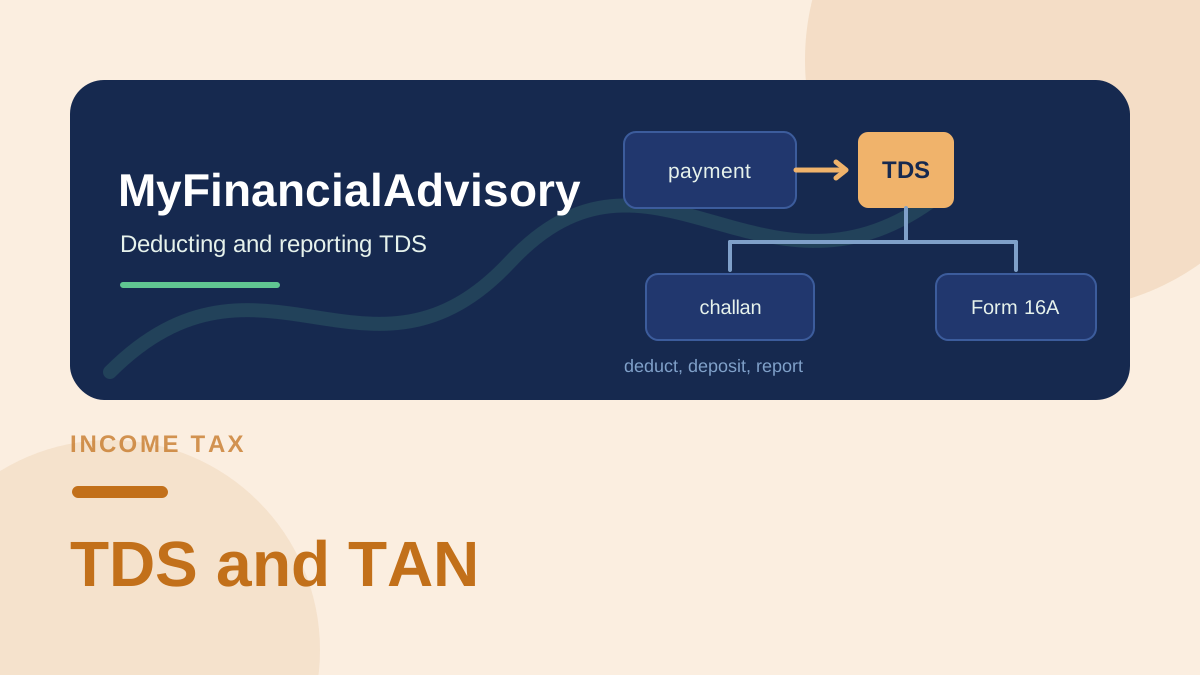
TDS on Payments to Non-Residents: Section 393(2), Treaty Relief and the Form 145 Remittance File
The complete seventeen-row section 393(2) table, what serial number 17 actually catches, treaty relief under section 159 and Form No. 41, the Rule 217 no-PAN relief, and the Form No. 145 and 146 paperwork your bank asks for before it releases the money.
Read guideIncome Tax
TDS Forms Under the Income-tax Rules, 2026: Which Form, and By When
The Income-tax Rules, 2026 renumbered every TDS form. Forms 138, 140, 143 and 144 for the quarterly statements, Form 141 for the challan-cum-statement, Forms 130 to 133 for certificates, 134 and 135 for a TAN and 128 for a lower-deduction certificate — each with the rule it comes from and the date it is due.
Read guideIncome Tax
TDS Return Filing Guide
The full TDS cycle for a deductor — TAN, deduction, deposit by the 7th, the quarterly 24Q/26Q/27Q statement, Form 16 and 16A, and the fees, interest and penalties when a step slips. Updated for the section 392/393/394 renumbering from 1 April 2026.
Read guide