
Your Company's First Financial Year and First AGM
Every first-year deadline a company has descends from one date — the date on the certificate of incorporation. Here is the derivation, including the section 2(41) rule that gives a company incorporated in January a fifteen-month first year.
On this page
- Quick answer
- Who this is for
- Step one: your first financial year, which is probably not twelve months
- Step two: the first AGM
- Step three: AOC-4 and MGT-7, and the rule that costs people money
- Step four: everything else in year one
- The ADT-1 trap
- INC-20A, and why it is the one to take seriously
- The full derivation, worked twice
- Example A — incorporated 12 December 2025
- Example B — incorporated 12 January 2026
- What being late costs in year one
- Common mistakes in year one
- What to do with your certificate of incorporation
- Sources and currency
Quick answer
Every deadline in a company's first year descends from a single date: the one on the certificate of incorporation. The chain runs incorporation date → first financial year end → first AGM → AOC-4 and MGT-7, and the first link is where people go wrong. Under section 2(41), a company incorporated on or after 1 January takes its first financial year to *31 March of the following year — so a January incorporation has a first year of nearly fifteen months*, not three.
Who this is for
You have just incorporated a private limited company, or you are about to, and you want to know exactly what you owe and when — derived, not guessed. It is written for the founder or director who has the certificate of incorporation in front of them and wants to build a calendar from it.
It covers a company with a 31 March financial year end, which is the overwhelming majority. It does not cover the recurring annual cycle once year one is behind you — that is the ROC annual filing checklist — and it does not cover LLPs, which have no AGM and a different set of forms.
Step one: your first financial year, which is probably not twelve months
Everything downstream depends on this, and it is the step most first-year calendars get wrong.
Section 2(41) defines a financial year, in relation to any company or body corporate, as:
the period ending on the 31st day of March every year, and where it has been incorporated on or after the 1st day of January of a year, the period ending on the 31st day of March of the following year, in respect whereof financial statement of the company or body corporate is made up
So the rule is not "your first year ends on the next 31 March". It is:
- Incorporated 1 April to 31 December → first financial year ends on the coming 31 March. That year is between three and twelve months long.
- Incorporated 1 January to 31 March → first financial year ends on *31 March of the following year*. That year is between twelve and fifteen months long.
A company incorporated on 10 January 2026 therefore has a first financial year running from 10 January 2026 to 31 March 2027 — a first set of accounts covering nearly fifteen months. A company incorporated on 10 December 2025 closes its first year on 31 March 2026, after under four months.
The point of the rule is to stop a company incorporated in, say, February from having to prepare, audit and file a full set of statutory accounts for a six-week stub period. The practical effect is that a January, February or March incorporation has no annual filing obligation at all in its first calendar year of existence — and founders in that position quite reasonably but wrongly conclude something has gone missing.
Two footnotes. The provisos to section 2(41) let the Central Government allow a different financial year, on application, to a company that is a holding, subsidiary or associate of a company incorporated outside India and needs to align with an overseas consolidation — that power moved from the Tribunal to the Central Government by the Companies (Amendment) Act, 2019. And an OPC follows the same section 2(41) definition, but has no AGM at all, which changes everything downstream of it.
Step two: the first AGM
Section 96(1) requires every company other than a One Person Company to hold an annual general meeting each year, and provides that not more than fifteen months may elapse between one AGM and the next.
The first proviso sets the first-year rule:
the first annual general meeting shall be held within nine months from the date of closing of the first financial year
and in any other case within six months of the year end. The second proviso adds that a company which holds its first AGM within that window need not hold an AGM in the year of its incorporation.
Then the third proviso — and this is the sentence that matters most for year one:
the Registrar may, for any special reason, extend the time within which any annual general meeting, other than the first annual general meeting, shall be held, by a period not exceeding three months
The first AGM cannot be extended. For every subsequent year, a company in difficulty can apply in GNL-1 under the purpose "Extension of AGM" and, if the Registrar is persuaded, gain up to three months. In year one that door is closed. The nine months is the entire allowance, and there is no relief mechanism behind it.
That is worth pausing on, because the nine months already looks generous and founders treat it as slack. It is not slack — it is the whole runway, and it has to accommodate finalising the first set of accounts and completing the first statutory audit.
Step three: AOC-4 and MGT-7, and the rule that costs people money
Once the AGM is fixed, the two annual filings follow:
- AOC-4, the financial statements — within thirty days of the AGM, under section 137(1).
- MGT-7 or MGT-7A, the annual return — within sixty days of the AGM, under section 92(4).
Read literally, that suggests a late AGM produces a late — but proportionately later — filing deadline. It does not, and this is the single most valuable thing to know about the ROC calendar.
MCA's own fee logic, published in the AOC-4 and MGT-7 instruction kits, sets the event date as:
Calculated AGM date or Calculated due date of AGM whichever is earlier
where the calculated AGM date is the actual (or adjourned) AGM date, and the calculated due date is the AGM due date, or the extended due date where an extension was granted.
The consequence:
- Holding the AGM early pulls the AOC-4 and MGT-7 deadlines forward.
- Holding the AGM late does not push them back. The due date caps the clock.
- Only an approved extension moves the cap — and in year one there is no extension available.
So for a first AGM, the AOC-4 deadline is 30 days from the earlier of your actual first AGM and the nine-month due date, and MGT-7 is 60 days from the same point. Delaying the meeting buys nothing at all; it only shortens the time left to file.
Section 137(1) also handles the awkward cases: statements adopted at an adjourned AGM are filed within thirty days of that adjourned meeting, and under section 137(2), where no AGM has been held, the statements plus a statement of the facts and reasons go in within thirty days of the last date on which the AGM should have been held. There is no version of events in which not holding the meeting removes the filing.
Step four: everything else in year one
Four obligations run from the incorporation date itself and are due long before the first AGM. They are the ones that actually get missed, because they arrive while the company is still setting up a bank account.
| Obligation | Provision | Due |
|---|---|---|
| First board meeting | s.173(1) | Within 30 days of incorporation |
| First auditor appointed by the Board | s.139(6) | Within 30 days of registration; on the Board's failure, the members at an EGM within 90 days |
| ADT-1 for the first auditor | s.139(6); MCA's ADT-1 kit | 30 days from incorporation |
| Registered office in place | s.12(1) | Within 30 days of incorporation |
| INC-22 verification of registered office | s.12(2) | Within 30 days of incorporation, where the flag was set at incorporation |
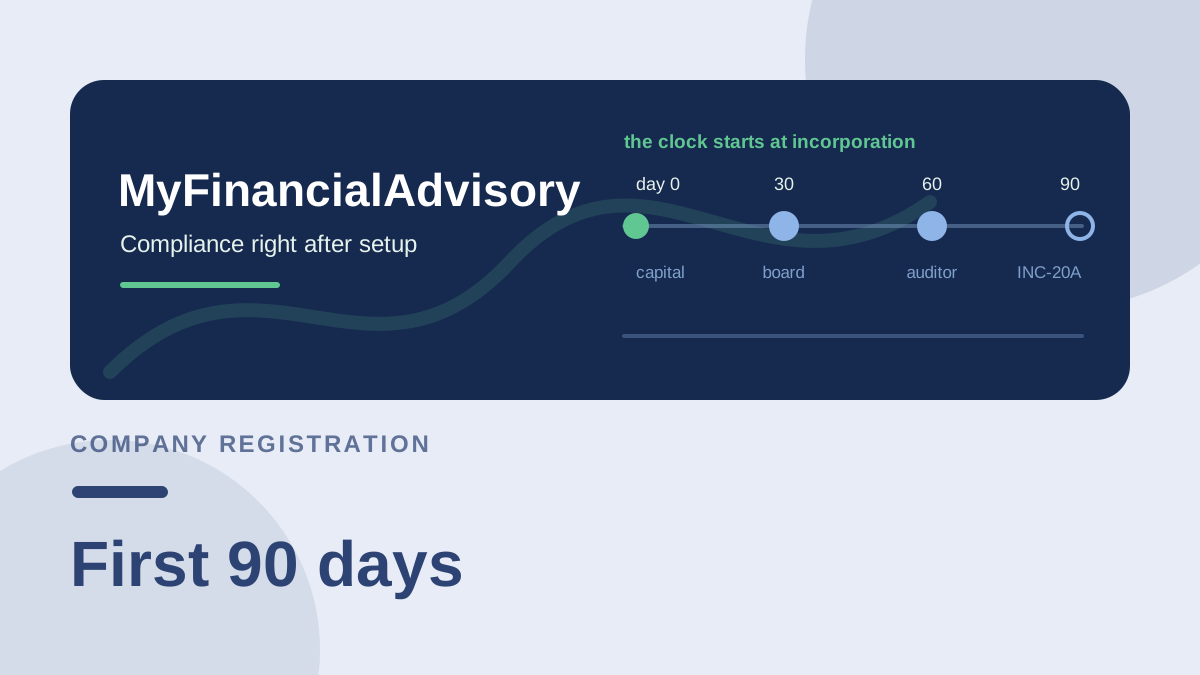
| INC-20A declaration of commencement | s.10A(1)(a) | Within 180 days of incorporation |
| DIR-3 KYC for each director | Rule 12A | By 30 September of the following financial year |
The ADT-1 trap
A great deal of published material says "ADT-1 within 30 days". That is right for the first auditor and wrong as a general statement.
- First auditor: appointed by the Board within 30 days of registration under section 139(6), and MCA's ADT-1 kit sets the event date as the date of incorporation with a 30-day limit.
- Any auditor appointed at a meeting: the third proviso to section 139(1) requires the company to file notice with the Registrar within fifteen days of the meeting in which the auditor was appointed.
So the number changes the moment you move from the first appointment to an appointment at an AGM. In year one you use 30 days; from the first AGM onwards, 15.
INC-20A, and why it is the one to take seriously
Under section 10A(1), a company incorporated after the Companies (Amendment) Act, 2019 and having a share capital shall not commence business or exercise any borrowing powers unless a director files a declaration within 180 days of incorporation that every subscriber has paid the value of the shares agreed to be taken, and the company has filed verification of its registered office under section 12(2).
Two things follow. First, the subscribers actually have to pay for their shares — INC-20A is a declaration that the money moved, and it cannot honestly be filed if it did not. Second, until it is filed the company legally cannot commence business or borrow.
The penalty under section 10A(2) is ₹50,000 on the company and ₹1,000 per day on every officer in default, up to ₹1,00,000. And under section 10A(3), where no declaration is filed within 180 days and the Registrar has reasonable cause to believe the company is not carrying on business, he may initiate removal of the name — indeed section 248(1)(d) names this precise failure as a strike-off ground. A company can therefore be struck off for never having filed a form that was due in its first six months.
The full derivation, worked twice
Both examples assume a private limited company with share capital, two subscribers who are also the two directors, a 31 March financial year end, and no AGM extension (which, for a first AGM, is not available in any case).
Example A — incorporated 12 December 2025
| Milestone | Derivation | Date |
|---|---|---|
| Incorporation | Certificate | 12 December 2025 |
| First board meeting | +30 days, s.173(1) | 11 January 2026 |
| First auditor appointed | +30 days, s.139(6) | 11 January 2026 |
| ADT-1 filed | 30 days from incorporation | 11 January 2026 |
| INC-22, if flagged | +30 days, s.12(2) | 11 January 2026 |
| First financial year ends | Incorporated before 1 January → the coming 31 March | 31 March 2026 |
| INC-20A | +180 days, s.10A(1)(a) | 10 June 2026 |
| First AGM due | +9 months from year end, s.96(1) 1st proviso | 31 December 2026 |
| AOC-4 due | +30 days from the earlier of actual AGM and due date | 30 January 2027 |
| MGT-7 due | +60 days from the same point | 1 March 2027 |
Note the compression: the first financial year is under four months long, but a full set of accounts must still be prepared and audited for it.
Example B — incorporated 12 January 2026
| Milestone | Derivation | Date |
|---|---|---|
| Incorporation | Certificate | 12 January 2026 |
| First board meeting | +30 days, s.173(1) | 11 February 2026 |
| First auditor appointed | +30 days, s.139(6) | 11 February 2026 |
| ADT-1 filed | 30 days from incorporation | 11 February 2026 |
| INC-22, if flagged | +30 days, s.12(2) | 11 February 2026 |
| First financial year ends | Incorporated on or after 1 January → 31 March of the following year | 31 March 2027 |
| INC-20A | +180 days, s.10A(1)(a) | 11 July 2026 |
| First AGM due | +9 months from year end | 31 December 2027 |
| AOC-4 due | +30 days from the earlier of actual AGM and due date | 30 January 2028 |
| MGT-7 due | +60 days from the same point | 1 March 2028 |
One month's difference in the incorporation date moves the first AGM by a full year, and the first financial year from under four months to nearly fifteen. Both companies still owe INC-20A within 180 days, and both still owe the 30-day cluster.
And if the AGM in Example A is actually held on 20 October 2026 rather than the 31 December due date? Then the event date becomes 20 October 2026, because it is the earlier of the two — AOC-4 falls due 19 November 2026 and MGT-7 on 19 December 2026. Holding it early moved both deadlines forward by more than two months. Holding it late, on say 15 January 2027, would leave the due date of 31 December 2026 as the cap, so AOC-4 would still have been due 30 January 2027 and would already be running late.
What being late costs in year one
Two distinct charges, and a company can owe both.
Additional fee. For AOC-4 and MGT-7 only, delay carries ₹100 per day per form with no upper cap, under the first proviso to section 403 as prescribed by the fee rules. It is per form, so a company late on both accrues ₹200 a day. Do not generalise this rate — INC-20A, INC-22, ADT-1 and most other forms are on a multiplier table instead, from 2x to 12x of the normal fee by delay band.
Penalty. Separately, section 137(3) and section 92(5) impose penalties starting at ₹10,000 on the company, capped at ₹2,00,000, with officers separately liable and capped at ₹50,000. Section 99 deals with default in holding the AGM itself — a fine up to ₹1,00,000 and a further fine up to ₹5,000 for each day of continuing default.
And the one that follows the people rather than the company: section 164(2)(a) disqualifies a director for five years, in that company and in every other company, once the company has not filed financial statements or annual returns for any continuous period of three financial years.
Common mistakes in year one
- Assuming the first financial year ends at the next 31 March. For a January to March incorporation it does not, and every date downstream shifts by a year.
- Treating the nine months as extendable. The third proviso to section 96(1) excludes the first AGM from the Registrar's extension power.
- Delaying the AGM to buy filing time. It does the opposite: the due date caps the clock, so a late meeting only shortens what is left.
- Applying "ADT-1 in 30 days" to every appointment. Fifteen days from the meeting, once you are past the first auditor.
- Filing INC-20A without the subscription money having moved. It is a declaration that it has.
- Missing the 30-day cluster — first board meeting, first auditor, ADT-1, INC-22 — because it lands while the company is still opening a bank account.
- Forgetting DIR-3 KYC for directors who received a DIN through SPICe+. It is free by 30 September and ₹5,000 afterwards, with the DIN deactivated in between.
What to do with your certificate of incorporation
Take the date on it and work down the chain:
- Incorporation date +30 days → first board meeting, first auditor, ADT-1, and INC-22 if the flag was set.
- Incorporation date +180 days → INC-20A.
- Apply section 2(41) — before or on/after 1 January — to fix the first financial year end.
- Year end +9 months → first AGM due date. Not extendable.
- Earlier of actual AGM and that due date, +30 days → AOC-4; +60 days → MGT-7.
- 30 September of the following financial year → DIR-3 KYC for every director.
- From year two, the AGM window becomes six months, extensions become available, and you are on the recurring cycle in the ROC annual filing checklist.
If you would rather have this built for you and kept running, our post-incorporation compliance service does exactly this from your certificate of incorporation, and hands over into the ongoing company compliance calendar.
Sources and currency
Applies to: Companies incorporated under the Companies Act, 2013 with a 31 March financial year end. India — position as at 20 August 2026.
Sections 2(41), 10A, 12, 92, 96, 137, 139 and 173 were read from the consolidated bare Act on India Code on 2026-08-20, in their current amended form. Dates below are derived arithmetically from those provisions and stated with their assumptions. Confirm your own position before relying on any date here.
- Companies Act, 2013 — consolidated bare Act (India Code): s.2(41) financial year, s.96 AGM, s.137 financial statements, s.92 annual return, s.139 auditors, s.10A commencement, s.12 registered office, s.173 board meetings
- MCA instruction kit — Form INC-20A (180 days from incorporation)
- MCA instruction kit — Form ADT-1 (15 days from the meeting; 30 days from incorporation for the first auditor)
- MCA instruction kit — Form INC-22 (30 days from incorporation where the flag is set)
- MCA instruction kit — Form AOC-4 (event date is the earlier of the AGM date and the AGM due date)
Frequently asked questions
How long is a company's first financial year?
It depends entirely on the month of incorporation. Section 2(41) says a financial year ends on 31 March, but where a company is incorporated on or after 1 January of a year, its first financial year runs to 31 March of the following year. So a company incorporated on 10 January 2026 has a first financial year of nearly fifteen months, ending 31 March 2027, while one incorporated on 10 December 2025 closes its first year on 31 March 2026 after under four months.
When is the first AGM due?
Within nine months from the close of the first financial year, under the first proviso to section 96(1). Every later AGM is within six months of the year end, and no more than fifteen months may elapse between one AGM and the next. A company that holds its first AGM within the nine months need not hold an AGM in its year of incorporation.
Can the Registrar extend the first AGM?
No. The third proviso to section 96(1) allows the Registrar to extend the time for holding an AGM by up to three months for special reason, but it expressly excludes the first AGM. The nine-month window is the whole of it.
Does holding the AGM late give me more time to file AOC-4?
No. MCA's fee logic counts from the earlier of your actual AGM date and the AGM due date. Holding the meeting early pulls the AOC-4 and MGT-7 deadlines forward; holding it late does not push them back, because the due date caps the clock. Only an approved extension moves the cap, and it is not available for a first AGM.
Is ADT-1 due within 30 days?
For the first auditor, yes — the event date is the date of incorporation and the time limit is 30 days. But as a general statement it is wrong. Where an auditor is appointed at a meeting, the third proviso to section 139(1) requires notice to the Registrar within fifteen days of that meeting.
What is INC-20A and when is it due?
It is the declaration of commencement of business under section 10A(1)(a), due within 180 days of incorporation, confirming that every subscriber has paid the value of the shares agreed to be taken and that the registered office has been verified. A company having share capital cannot commence business or exercise borrowing powers until it is filed.
What happens if INC-20A is not filed?
Section 10A(2) imposes a penalty of ₹50,000 on the company and ₹1,000 for each day of continuing default on every officer in default, up to ₹1,00,000. Under section 10A(3) the Registrar may also initiate removal of the company's name from the register, and section 248(1)(d) lists exactly this as a ground.
When is the first board meeting due?
Within thirty days of the date of incorporation, under section 173(1). Thereafter a minimum of four board meetings each year with not more than one hundred and twenty days between two consecutive meetings, subject to the lighter regime in section 173(5) for an OPC, small company or dormant company.
Related MFA services
If you want this handled rather than done yourself, these are the matching services.
Written by
MyFinancialAdvisory Editorial
Editorial guidance prepared for business owners and reviewed before production publication.
Written against official sources, with the governing rule named wherever a figure or deadline is given. General guidance — not advice on your specific case.
Ready to act?
Get your first-year calendar built from your incorporation date
We derive every year-one deadline from your certificate of incorporation, file the first-year forms in sequence, and hand you a calendar that carries into the recurring cycle.
Related guides
Company Registration
Post-Incorporation Compliance for a Private Limited Company
Incorporation is day one — the compliance clock starts immediately. Here is the first-year checklist every Private Limited Company must follow: INC-20A, auditor, share certificates, KYC and annual filings.
Read guide
MCA Compliance
ROC Annual Filing Checklist
Every ROC filing a company owes each year, the forms, the fees, and the one deadline rule most summaries get wrong — with a worked derivation and an incorporation-month deadline table.
Read guide
MCA Compliance
Company Compliance Checklist: Annual & Event-Based
The full compliance load on a private limited company — first-year filings, the annual cycle, and the event-based forms — with sections, time limits, real fees and a worked first-year timeline.
Read guide