
Trademark Renewal Process: Keep Your Brand Alive
A trademark lasts 10 years — then it must be renewed, or you can lose it. Here is how renewal works, the grace and restoration windows, and how to never miss it.
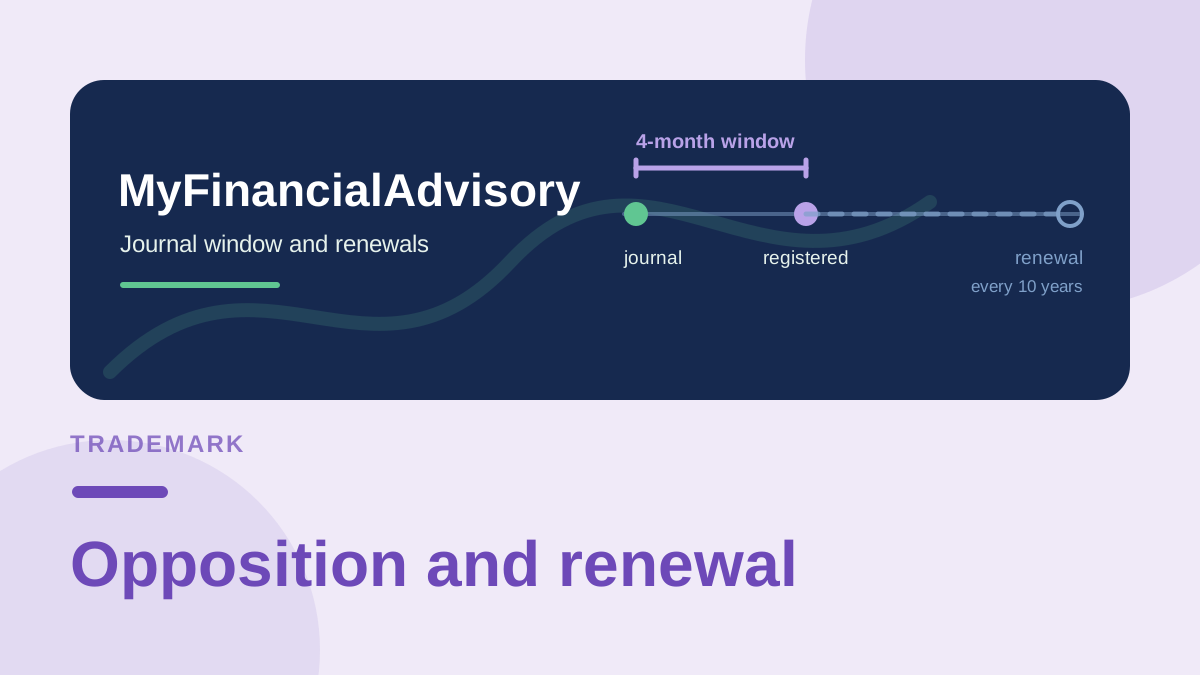
Brands spend years building recognition, then quietly lose their trademark by forgetting a renewal date. Renewal is simple — the danger is only in forgetting it.
Quick answer
A registered trademark is valid for 10 years from the date of application and can be renewed indefinitely in 10-year blocks by filing form TM-R. Renew before expiry to avoid a surcharge. There is a grace period (with surcharge) after expiry, and a further restoration window if the mark is removed.
The renewal timeline
- Before expiry: renew normally with the government fee
- Grace period (after expiry): renew with a surcharge
- Restoration window: restore a removed mark with the prescribed surcharge
- Beyond that: the mark can be lost and even claimed by others
Why renewal matters
A lapsed, unrestored trademark loses its protection — and someone else may register it. All the brand equity you built becomes vulnerable. Renewal is the cheapest way to protect it.
How to never miss it
- Diarise the renewal date the moment you register
- Renew a few months early to avoid any risk
- Use a provider who tracks and reminds you
Common mistakes
- Missing the renewal date and paying a surcharge
- Letting the mark lapse and lose protection
- Forgetting to renew in every registered class
- Not updating proprietor details before renewing
Renewal is a 10-yearly formality — but missing it can undo a decade of brand building. Keep it on a calendar.
Ready to act?
Don't let your brand lapse
We track your renewal date and file on time — and can restore a lapsed mark where the window is still open.
Frequently asked questions
How often must a trademark be renewed?
Every 10 years from the date of application. It can be renewed indefinitely in 10-year blocks.
What happens if I miss the renewal date?
There is a grace period after expiry to renew with a surcharge, and a further window to restore a removed mark. Beyond that, the mark can be lost.
How do I renew a trademark?
By filing form TM-R with the government renewal fee, before expiry where possible.
Can a lapsed trademark be restored?
Often yes, within the restoration window after removal, with the prescribed surcharge. The sooner you act, the better.
Do I renew in every class?
Yes, renewal applies to each class in which the mark is registered, with fees per class.
Does using the registered symbol require renewal?
Yes — it reflects a live registration, which must be renewed every 10 years to remain valid.
Related MFA services
If you want this handled rather than done yourself, these are the matching services.
Written by
MyFinancialAdvisory Editorial
Editorial guidance prepared for business owners and reviewed before production publication.
Reviewed by MyFinancialAdvisory IP Team
Written against official sources, with the governing rule named wherever a figure or deadline is given. General guidance — not advice on your specific case.
Ready to act?
Don't let your brand lapse
We track your renewal date and file on time — and can restore a lapsed mark where the window is still open.
Related guides
Trademark
Trademark Registration Process in India
Trademark registration is a sequence of statutory stages, not a single filing. Here is the full path from search to the R symbol — the forms, the fees, the statutory deadlines at every stage, what happens when an objection or an opposition lands, and how to file something that survives examination.
Read guideTrademark
Trademark Registration Cost in India (2026)
The government fee is ₹4,500 or ₹9,000 per class per mark online, set by the First Schedule to the Trade Marks Rules, 2017 — and that is only the first line of the bill. Here is every official fee across the life of a trademark, what drives the total, and how to read a quotation that blends the two kinds of cost.
Read guide
Trademark
How to Protect a Brand Name in India: The Full Playbook
A great brand name is worthless if a competitor can use it too. Here is the step-by-step playbook to legally protect a brand name in India — search, class, file, monitor and enforce.
Read guide