
Tax Audit Applicability: When Section 44AB Applies
Whether a tax audit applies to you, answered for both years that are open at once — section 44AB for AY 2026-27 and section 63 for tax year 2026-27 — with the turnover tests, the presumptive trap, the books-of-account obligation that bites far lower, and what a late report now costs.

On this page
- Quick answer
- Which year are you asking about
- Business turnover thresholds
- The ₹10 crore relief needs both tests, not either
- Professional receipts threshold
- The presumptive twist
- The ceilings under section 58
- Declaring below the deemed figure is itself a trigger
- Books of account: a separate, much lower obligation
- Forms and deadlines
- Assessment year 2026-27 — Forms 3CA/3CB and 3CD
- Tax year 2026-27 — Form No. 26
- The return date moves with the audit
- Worked examples
- Example 1 — the ₹10 crore relief, lost on the payments side
- Example 2 — below the turnover threshold, in audit anyway
- Example 3 — a professional under the receipts threshold
- Example 4 — books, but no audit
- Reconcile with GST
- What else your turnover switches on
- What happens if you miss it
- Common mistakes
- What this page does not claim
- Where to go next
- Sources and currency
Quick answer
A tax audit is an examination of your accounts by a chartered accountant, required when your turnover or gross receipts cross a prescribed threshold — or, separately, when you declare presumptive income below the deemed figure. The report is filed before the income-tax return, and the return date moves with it.
Which provision you are under depends on the year, because two are live at once:
| Your question is about | Income of | Governing Act | Provision | Report on | Report due |
|---|---|---|---|---|---|
| Assessment year 2026-27 | FY 2025-26 | Income-tax Act, 1961 | s.44AB | Form 3CA or 3CB, plus Form 3CD | 30 September 2026 |
| Tax year 2026-27 | FY 2026-27 | Income-tax Act, 2025 | s.63 | Form No. 26 | 30 September 2027 |
The thresholds are the same on both sides of that line: ₹1 crore of business turnover, ₹10 crore where the business is almost entirely non-cash, ₹50 lakh of professional gross receipts. What changes is the section, the form, and what a late report costs.
Which year are you asking about
Settle this before any threshold is useful.
The Income-tax Act, 2025 came into force on 1 April 2026, under section 1(3) of that Act. It does not govern assessment year 2026-27, which is the assessment year for income of FY 2025-26 and is charged under the Income-tax Act, 1961. The Finance Act, 2026 makes this unusually clear by carrying two separate charging sections: one for the assessment year commencing 1 April 2026 under the 1961 Act, one for the tax year commencing 1 April 2026 under the 2025 Act.
The repeal did not sweep the old year away either. Section 536(2)(c) keeps the repealed Act applying to proceedings in respect of any tax year beginning before 1 April 2026 — including proceedings initiated after that date. A notice or a penalty about FY 2025-26 that lands in 2027 is still a 1961 Act matter.
So: closing FY 2025-26 puts you on section 44AB; planning for the year that began 1 April 2026 puts you on section 63. Our guide to the Income-tax Act, 2025 for business owners sets out the wider two-track picture; this page stays on audit.
Business turnover thresholds
A business is subject to tax audit where total sales, turnover or gross receipts exceed ₹1 crore in the year, rising to ₹10 crore for a business that is substantially non-cash.
That is section 63(1) of the Income-tax Act, 2025 for tax year 2026-27. The same figures apply for AY 2026-27 under section 44AB: the Income Tax Department states directly that the tax audit thresholds remain the same as they were under the old Act, and the section 63 table reproduces them.
The ₹10 crore relief needs both tests, not either
This is where the relief is most often claimed wrongly. The higher threshold applies where cash receipts are 5% or less of total receipts and cash payments are 5% or less of total payments. Both. Not either.
| Cash receipts ≤ 5% of receipts | Cash payments ≤ 5% of payments | Threshold |
|---|---|---|
| Yes | Yes | ₹10 crore |
| Yes | No | ₹1 crore |
| No | Yes | ₹1 crore |
| No | No | ₹1 crore |
A business that collects almost everything by bank transfer but still pays a large part of its costs in cash stays on ₹1 crore. Two habits make the payments side fail unnoticed: petty cash run properly but at scale, and cash wages. Neither is unlawful; both count against the 5%. Both ratios are knowable well before year-end, so put them on the monthly management pack rather than discovering the answer in September.
Professional receipts threshold
A profession is subject to tax audit where gross receipts exceed ₹50 lakh in the year. That is the whole test — there is no cash-percentage relief on the professional side and no ₹10 crore equivalent, so a consultant billing ₹60 lakh entirely by bank transfer is in audit.
Two points that catch people:
- The measure is gross receipts, not profit and not invoiced value. Money received in the year is what counts.
- A person can be running a business and a profession. The tests apply to each, on their own figures.
The presumptive twist
The turnover tests are not the only route into an audit, and the second one catches people where they were confident no audit could apply.
The ceilings under section 58
Under section 58 of the Income-tax Act, 2025 — successor to the presumptive provisions of the old Act — the schemes and ceilings for tax year 2026-27 are:
| Who | Ceiling | Deemed income |
|---|---|---|
| Eligible business | ₹2 crore, or ₹3 crore where cash receipts are 5% or less of turnover | 6% of receipts through banking or prescribed electronic modes, plus 8% of the rest — or the actual profit, if higher |
| Specified profession | ₹50 lakh, or ₹75 lakh where cash receipts are 5% or less of gross receipts | 50% of gross receipts |
Note the shape of the business rate: it is not a flat 6%. It is 6% on the banked and online portion and 8% on everything else, added together, so a blended rate has to be computed rather than assumed. Note too that the deemed figure is a floor: where the actual profit is higher, the actual profit is the income.
Declaring below the deemed figure is itself a trigger
The audit provision lists this separately from the turnover tests: an audit is required where a person declares presumptive income lower than the deemed profit. Read as worded, the limb bites where the declaration is below the deemed figure and total income is above the maximum amount not chargeable to tax — so a genuinely small year is not swept in.
The consequence: you can be well below ₹1 crore of turnover and still be in audit. A trader at ₹70 lakh whose real margin is 2% is not protected by the turnover threshold. Declare that 2% rather than the deemed figure and the audit follows from the declaration itself.
That is a real decision, not a trap to be dodged by reflex. Declaring the deemed figure means tax on a profit you did not make; declaring the real figure means an audit. Cost both before choosing.
One knock-on: a presumptive assessee pays advance tax in a single instalment by 15 March rather than in four. Stepping out puts you back on the ordinary instalment pattern, with interest under sections 424 and 425 of the 2025 Act — successors to sections 234B and 234C — if the timing slips. Our advance tax guide covers the instalments.
Books of account: a separate, much lower obligation
A frequent misreading is that below the audit threshold there is nothing to do. Section 62 of the Income-tax Act, 2025 requires books of account where, in any one of the three preceding years:
| Person | Income above | or turnover/gross receipts above |
|---|---|---|
| Individual or HUF | ₹2,50,000 | ₹25,00,000 |
| Any other person | ₹1,20,000 | ₹10,00,000 |
Those figures are an order of magnitude below the audit thresholds, so the ordinary position for a small business is books without an audit, not neither. And when turnover does cross ₹1 crore, an auditor handed three years of maintained books has a very different job. If bookkeeping is the gap, bookkeeping services and monthly accounting are the place to start.
Forms and deadlines
The report is filed before the return, not with it, and an audited assessee's return date is later than everyone else's.
Assessment year 2026-27 — Forms 3CA/3CB and 3CD
The Income Tax Department confirms that for FY 2025-26 the report is filed on the existing forms under the 1961 Act: Form 3CA where the accounts are already audited under another law — a company under the Companies Act, for instance — or Form 3CB where they are not, plus Form 3CD, the statement of particulars. The Department states the due date as 30 September 2026.
Tax year 2026-27 — Form No. 26
For tax year 2026-27 the report goes on Form No. 26 under the Income-tax Rules, 2026, which the Department describes as merging the erstwhile Forms 3CA, 3CB and 3CD into one. The due date follows from the Act rather than a notification: section 63(5)(a) fixes the specified date at one month before the return due date under section 263(1). That return is due 31 October 2027, so the report is due 30 September 2027.
The return date moves with the audit
Whether an audit applies changes your return date. This is the enacted due-date table, which appears in identical terms under both Acts:
| Your position | AY 2026-27 | Tax year 2026-27 |
|---|---|---|
| Transfer-pricing report applies | 30 November 2026 | 30 November 2027 |
| Company; any assessee whose accounts must be audited; partner of an audited firm | 31 October 2026 | 31 October 2027 |
| Business or professional income, not subject to audit; partner of a non-audited firm | 31 August 2026 | 31 August 2027 |
| Any other assessee | 31 July 2026 | 31 July 2027 |
The last row is the residual one: a salaried filer with no business or professional income sits there and files by 31 July. Only business or professional income moves the date to 31 August; only audit moves it to 31 October.
The form follows your entity, not the audit: ITR-3 for an individual or HUF with business or professional income, ITR-5 for a firm or LLP, ITR-6 for a company. Our ITR filing guide covers form choice; business ITR filing, company ITR filing and LLP ITR filing are the services.
Worked examples
Example 1 — the ₹10 crore relief, lost on the payments side
Assumptions: a private limited company, trading, FY 2025-26 — so assessment year 2026-27, under section 44AB. Turnover and total receipts ₹6.4 crore, of which ₹18,00,000 in cash. Total payments ₹6.1 crore, of which ₹41,00,000 in cash (petty cash and site wages). No presumptive scheme.
- Cash receipts: ₹18,00,000 ÷ ₹6,40,00,000 = 2.81% — passes.
- Cash payments: ₹41,00,000 ÷ ₹6,10,00,000 = 6.72% — fails.
One failure loses the ₹10 crore threshold, so it stays at ₹1 crore and turnover of ₹6.4 crore is far above it. Audit applies. Because the company's accounts are already audited under the Companies Act, the report goes on Form 3CA with Form 3CD, by 30 September 2026; return by 31 October 2026.
Change one figure: cash payments of ₹28,00,000, or 4.59%. Both tests now pass, the threshold becomes ₹10 crore, and ₹6.4 crore is below it. No audit. A ₹13 lakh difference in how the same costs were settled is the whole of it.
Example 2 — below the turnover threshold, in audit anyway
Assumptions: a sole proprietor, trading, tax year 2026-27, under the Income-tax Act, 2025. Turnover ₹88,00,000 — ₹80,00,000 through banking and prescribed electronic modes, ₹8,00,000 in cash. Actual profit per the books ₹3,10,000. Total income above the maximum amount not chargeable to tax. Eligible for the presumptive scheme.
Deemed income under section 58: 6% of ₹80,00,000 = ₹4,80,000, plus 8% of ₹8,00,000 = ₹64,000, so ₹5,44,000.
Turnover of ₹88,00,000 is below ₹1 crore, so no turnover test is crossed. But declaring ₹3,10,000 is declaring below the deemed ₹5,44,000, and that is an independent trigger. Audit applies, at a turnover where the proprietor was confident none could.
The alternative is to declare ₹5,44,000 and stay out of audit — paying tax on ₹2,34,000 of profit never earned. Neither answer is automatically right; both should be costed.
Example 3 — a professional under the receipts threshold
Assumptions: an independent consultant, a specified profession, tax year 2026-27. Gross receipts ₹46,00,000, entirely by bank transfer. Actual profit ₹14,00,000 after genuine costs. Total income above the maximum amount not chargeable to tax.
Gross receipts are below ₹50 lakh, so the receipts test is not crossed. But the deemed income would be 50% of ₹46,00,000 = ₹23,00,000, and she declares ₹14,00,000. Below the deemed figure. Audit applies.
A profession with real costs — office rent, a salaried assistant, subcontracted work — routinely runs a margin under 50%, so this is the ordinary case. Report due 30 September 2027 on Form No. 26; return 31 October 2027 rather than 31 August 2027.
Example 4 — books, but no audit
Assumptions: a freelance designer, an individual, tax year 2026-27. Gross receipts ₹9,80,000, income ₹3,40,000. Income exceeded ₹2,50,000 in one of the three preceding years.
Receipts are nowhere near ₹50 lakh, so there is no audit. But income above ₹2,50,000 in a preceding year crosses the section 62 test for an individual, so books of account are required. Only one obligation is switched on here, and treating "no audit" as "no records" is how a routine query becomes a problem two years later.
Reconcile with GST
Your audited turnover should be consistent with what you have reported in your GST returns. Mismatches between income-tax and GST figures are a frequent audit and notice trigger, for the straightforward reason that both are reported to the government and can be placed side by side.
The two will rarely be identical, and need not be. What they need is a reconciliation explaining each difference. The usual, legitimate causes:
| Difference | Why it arises |
|---|---|
| Timing | A supply is recognised for GST and revenue is recognised in the books at points that do not always fall in the same period |
| Out-of-scope supplies | Amounts outside GST altogether still form part of turnover in the accounts |
| Other income | Interest, rent or a gain on sale of an asset is income but not business turnover |
| Credit notes and returns | Netted at a different time, or against a different period, in each system |
| Reimbursements | Recovered costs presented gross in one system and net in the other |
Do the reconciliation before the auditor asks. A difference already explained in a working paper is administration; the same difference found by someone else is answered under time pressure. Our GST return filing guide covers the return side, and GST return filing is the service.
What else your turnover switches on
Crossing an audit threshold rarely happens alone. The same figures appear in other obligations, which take effect without separate notice.
| Turnover or receipts | What it switches on |
|---|---|
| Income above ₹1,20,000 or turnover above ₹10 lakh (₹2,50,000 / ₹25 lakh for an individual or HUF) | Books of account — s.62 |
| Business above ₹1 crore, or ₹10 crore where both cash tests are met; profession above ₹50 lakh | Tax audit — s.63 (s.44AB for AY 2026-27) |
| Business above ₹1 crore, or profession above ₹50 lakh, in the immediately preceding tax year | "Specified person" for TDS — s.402(37) of the 2025 Act |
| Turnover above ₹50 crore | Electronic payment facility must be offered — s.187 |
The TDS consequence is most often missed. An individual or HUF that crosses the limit becomes a specified person for the following tax year, and from then deducts on rent, contract payments, commission and professional fees on the ordinary footing rather than the limited one. The TDS section crosswalk sets out which provision covers which payment.
What happens if you miss it
The consequences differ by year, and these are two separate rules rather than one replacing the other.
For assessment year 2026-27, the provision is section 271B of the Income-tax Act, 1961: a penalty for failing to get accounts audited where required, computed as a percentage of turnover, subject to a cap.
For tax year 2026-27, it is section 428(c) of the Income-tax Act, 2025, as substituted by the Finance Act, 2026 with effect from 1 April 2026 — a fee, and time-graded:
| Default | Delay up to one month | Thereafter |
|---|---|---|
| Failure to get accounts audited and furnish the section 63 report — s.428(c) | ₹75,000 | ₹1,50,000 |
| Failure to furnish the section 172 transfer-pricing report — s.428(d) | ₹50,000 | ₹1,00,000 |
The grading means the first month is worth defending: books that do not close fast enough to give the auditor a clear run at 30 September are now a costed problem, not an inconvenience.
Missing the audit also cascades into the return:
- A late return costs a fee — ₹1,000 where total income is ₹5,00,000 or less and ₹5,000 otherwise, under section 234F for AY 2026-27 and section 428(a) for tax year 2026-27. Losses may not carry forward either.
- Verification is part of filing. The return must be e-verified, or the ITR-V submitted, within 30 days. Verify later and the verification date becomes the date of furnishing — a return uploaded on 31 October and verified in December is late.
- A belated return for AY 2026-27 runs to 31 December 2026. Revision is a different and longer window: under section 139(5) that return may be revised up to the end of the assessment year — 31 March 2027 — or completion of assessment, whichever is earlier. 31 December is the belated boundary, not the revised one. Our revised, belated and updated return guide works through all three.
Common mistakes
- Assuming audit is only about turnover. Declaring below the deemed presumptive figure is an independent trigger and bites far below ₹1 crore.
- Claiming the ₹10 crore threshold on one test. Cash receipts and cash payments must each be 5% or less. Most failures are on the payments side.
- Reading the ₹10 crore relief into a profession. It does not exist there; ₹50 lakh of gross receipts is the whole test.
- Treating the presumptive business rate as a flat 6%. It is 6% on banked and electronic receipts plus 8% on the rest.
- Assuming no audit means no records. The section 62 books thresholds are an order of magnitude lower.
- Books that do not reconcile with GST. Explain each difference in a working paper before the audit.
- Filing the return first. The report goes in before the return.
- Assuming the 2025 Act governs your AY 2026-27 return. It does not — that is a 1961 Act return on Forms 3CA/3CB and 3CD, filed after the new Act commenced.
- Filing on time and verifying late. Thirty days, or the return is treated as furnished on the verification date.
- Discovering applicability in September. The cash percentages and the turnover trend are visible from month three.
What this page does not claim
Being explicit about the edges beats pretending there are none.
- We quote no text from the Income-tax Act, 1961. The verified source for the audit thresholds is the section 63 table of the 2025 Act plus the Income Tax Department's statement that the tax audit thresholds remain the same as under the old Act. That is why the AY 2026-27 figures are stated as the same figures rather than as a quotation from section 44AB.
- We do not restate the presumptive ceilings for AY 2026-27. The ₹2 crore / ₹3 crore and ₹50 lakh / ₹75 lakh ceilings and the 6% / 8% / 50% rates are read from section 58 of the 2025 Act and stated for tax year 2026-27. For AY 2026-27 the scheme is the presumptive provisions of the 1961 Act; the trigger is the same, but confirm the ceiling against the return utility.
- We do not define what counts as a cash receipt or a cash payment. The 5% tests are stated as the Act words them. That definitional detail is exactly what a borderline case turns on — take it from your auditor.
- We give no figure for the maximum amount not chargeable to tax, because it depends on the regime and the person.
- We do not compare section 271B with section 428(c). They are two current rules for two different years; presenting one as the replacement of the other would need the 1961 Act's own text, which we did not capture.
- We state no notification number and no extension. Due dates can be extended by notification; check the portal before relying on one.
Where to go next
If an audit applies, the next step is a timetable rather than a decision: books closed early enough to give the auditor a clear month, the report filed ahead of the return, the GST reconciliation done as a working paper rather than as a reply. Tax audit support is where we do that; income tax return filing is where the return sits.
If no audit applies, check the two obligations that do: books under section 62, and whether crossing ₹1 crore or ₹50 lakh has made you a specified person for TDS next year.
Sources and currency
Applies to: India. Assessment year 2026-27 (income of FY 2025-26) is governed by the Income-tax Act, 1961, including for proceedings begun after 1 April 2026. Tax year 2026-27 (income of FY 2026-27) is governed by the Income-tax Act, 2025, which commenced on 1 April 2026 under its section 1(3). Both are live at the same time, and this page answers for each separately.
Every threshold, form reference, date and fee on this page was read from the Gazette of India text of the Income-tax Act, 2025 and the Finance Act, 2026, and checked against the Income Tax Department's own e-filing guidance, on 19 August 2026. Where a rule depends on the Income-tax Rules rather than the Act, that is said plainly. This page quotes no text from the Income-tax Act, 1961 — see "What this page does not claim". Income-tax provisions change at each Finance Act; confirm the current position before relying on a figure for a filing.
- Income-tax Act, 2025 (No. 30 of 2025) — Gazette of India Extraordinary, 21 August 2025 (s.1(3) commencement, s.58 presumptive, s.62 books, s.63 audit, s.263 returns, s.536 savings)
- Finance Act, 2026 (No. 4 of 2026) — Gazette of India Extraordinary, 30 March 2026 (s.5 and s.66 return due dates, s.96 substituting s.427 and s.428)
- Income Tax Department, e-filing portal — Income Tax Forms (tax audit report forms and due dates)
- Income Tax Department, e-filing portal — Income Tax Returns
Frequently asked questions
When does a tax audit apply under section 44AB?
For assessment year 2026-27 — income of FY 2025-26 — a tax audit applies where business turnover exceeds ₹1 crore, or ₹10 crore if both cash tests are met, or where professional gross receipts exceed ₹50 lakh. It also applies where you declare presumptive income below the deemed figure. The auditor reports in Form 3CA or 3CB together with Form 3CD, and the report is due by 30 September 2026.
Is there a higher turnover threshold for a low-cash business?
Yes. The ₹1 crore business threshold rises to ₹10 crore where cash receipts are 5% or less of total receipts and cash payments are 5% or less of total payments. Both tests have to be satisfied. Passing one and failing the other leaves you on the ₹1 crore threshold, which is the single most common way this relief is claimed wrongly.
Can the presumptive scheme trigger a tax audit on its own?
Yes. Declaring income lower than the deemed figure under the presumptive scheme is an independent trigger, listed separately from the turnover tests, so it can bring you into audit at a turnover far below ₹1 crore. Under section 58 of the Income-tax Act, 2025 the deemed figure for an eligible business is 6% of receipts through banking or prescribed electronic modes plus 8% of the rest, and 50% of gross receipts for a specified profession.
What forms are used for a tax audit?
For AY 2026-27 the Income Tax Department confirms the existing forms under the 1961 Act: Form 3CA or Form 3CB, being the auditor's report, together with Form 3CD, the statement of particulars. For tax year 2026-27 the report goes on Form No. 26 under the Income-tax Rules, 2026, which merges the erstwhile Forms 3CA, 3CB and 3CD into one.
When is the tax audit report due?
For AY 2026-27 the Department states the due date as 30 September 2026, with the return for audit cases due 31 October 2026. For tax year 2026-27 the report is due 30 September 2027, because section 63(5)(a) fixes the specified date at one month before the return due date under section 263(1), and that return is due 31 October 2027. Dates can be extended by notification.
What is the penalty for missing a required audit?
It depends on the year. For AY 2026-27 the provision is section 271B of the Income-tax Act, 1961 — a penalty computed as a percentage of turnover and subject to a cap. For tax year 2026-27 section 428(c) of the Income-tax Act, 2025, as substituted by the Finance Act, 2026, imposes a fee of ₹75,000 where the delay is up to one month and ₹1,50,000 thereafter. These are two separate rules for two separate years, not one replacing the other.
Do I have to keep books of account even if no audit applies?
Very likely, and much sooner. Section 62 of the Income-tax Act, 2025 requires books where income exceeds ₹1,20,000 or turnover exceeds ₹10 lakh in any one of the three preceding years, relaxed to ₹2,50,000 and ₹25 lakh for an individual or HUF. Those figures sit far below every audit threshold, so the ordinary position is books without an audit, not neither.
Does my GST turnover have to match my audited turnover?
They do not have to be identical, but every difference should be explainable. Differences commonly arise from timing, from supplies that are outside GST, from other income that is not turnover at all, and from credit notes. What causes trouble is an unexplained gap, because both figures are reported to the government and can be compared. Reconcile before the audit rather than after a query.
Related MFA services
If you want this handled rather than done yourself, these are the matching services.
Written by
MyFinancialAdvisory Editorial
Editorial guidance prepared for business owners and reviewed before production publication.
Reviewed by MyFinancialAdvisory Tax Team
Written against official sources, with the governing rule named wherever a figure or deadline is given. General guidance — not advice on your specific case.
Ready to act?
Not sure which side of the threshold you are on?
Applicability checked against your actual books, the report prepared and filed ahead of the return, and the cash-percentage tests worked out properly rather than assumed.
Related guides
Income Tax
The Income-tax Act, 2025: What Actually Changed for an Indian Business from 1 April 2026
The new Act commenced on 1 April 2026, but it does not govern your AY 2026-27 return. This is what genuinely changed, what was only renumbered, and what to fix in your systems before the next quarter closes.
Read guide
Income Tax
Income Tax Return Filing for Business Owners
The whole compliance year for someone running a business with books, staff and vendors — ITR-3 versus ITR-4, the section 58 presumptive arithmetic, books and audit, the 31 August and 31 October dates, and the TDS your own business now owes.
Read guide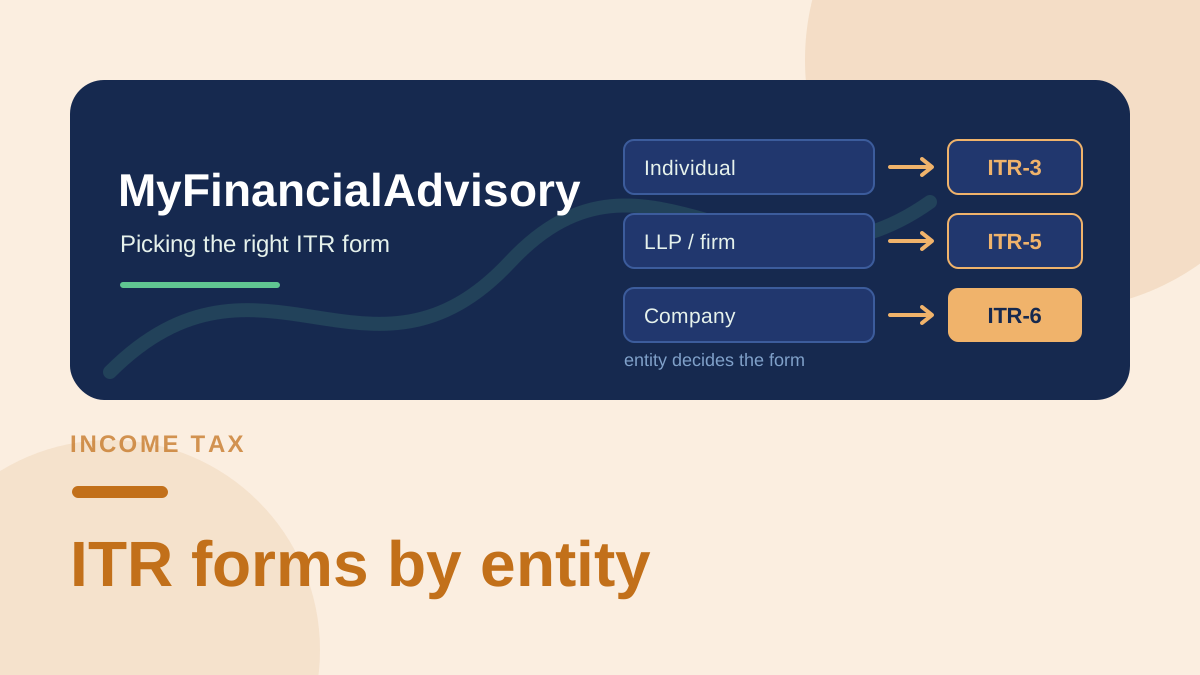
Income Tax
Company ITR Filing Guide: ITR-6, Tax Audit & Due Dates
A company's income-tax year end, start to finish — which return form, what feeds it, when the tax audit report is due, the 31 October date and the transfer-pricing exception, the company's own obligations as a deductor, and what a late return costs. Answered separately for assessment year 2026-27 and tax year 2026-27, because both are open at once.
Read guide