
Company ITR Filing Guide: ITR-6, Tax Audit & Due Dates
A company's income-tax year end, start to finish — which return form, what feeds it, when the tax audit report is due, the 31 October date and the transfer-pricing exception, the company's own obligations as a deductor, and what a late return costs. Answered separately for assessment year 2026-27 and tax year 2026-27, because both are open at once.
On this page
- Quick answer
- First, which year are you filing for
- ITR-6 and what feeds it
- The working order, and why it is an order
- Filing is mandatory whether or not the company traded
- Why we will not state a form number for tax year 2026-27
- Tax audit may apply
- The ₹10 crore relief needs both limbs, not either
- The report and the return are two filings, one month apart
- Getting the report onto the portal
- Due dates
- Verification is part of filing
- Worked examples
- Example 1 — the cash tests, and the calendar that follows from them
- Example 2 — TDS deducted, deposited late, and disallowed in this return
- The company as a deductor, not just a taxpayer
- The section split is not "everything is 393 now"
- Statements, deposits and certificates
- Advance tax runs alongside all of this
- Income tax vs ROC — do not confuse them
- Late filing, and what each failure actually costs
- Belated, revised and updated are three different windows
- The carry-forward is the expensive one
- If the tax audit is not done
- Deductor failures
- Common mistakes
- What this page does not claim
- Where to go next
- Sources and currency
Quick answer
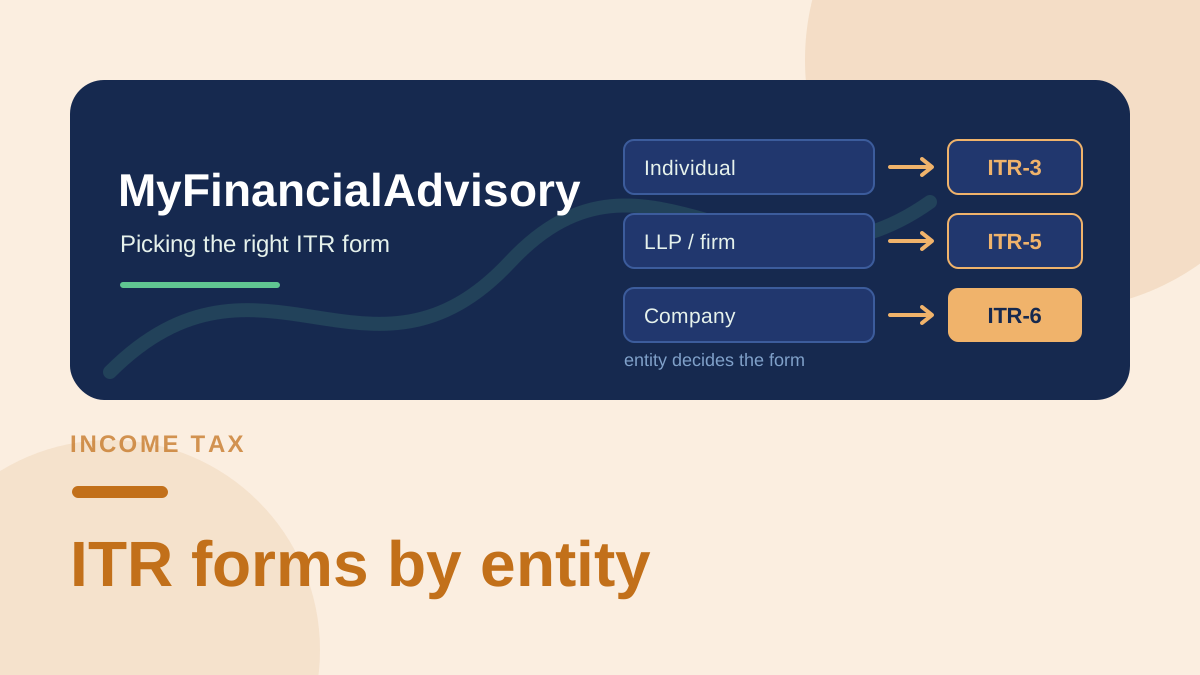
A company files its income tax return in ITR-6 (companies not claiming the section 11 exemption) for assessment year 2026-27, every year, regardless of profit or activity. It is prepared from audited financial statements, and it is separate from your MCA/ROC filings (AOC-4, MGT-7). Where turnover crosses the threshold, a tax audit report is furnished a month before the return. The return itself is due 31 October — 30 November where the transfer-pricing report applies.
First, which year are you filing for
Get this wrong and every answer below it is wrong too.
| Assessment year 2026-27 | Tax year 2026-27 | |
|---|---|---|
| Income of | FY 2025-26 (1 Apr 2025 – 31 Mar 2026) | FY 2026-27 (1 Apr 2026 – 31 Mar 2027) |
| Governing Act | Income-tax Act, 1961 | Income-tax Act, 2025 |
| Return provision | section 139 | section 263 |
| Company's return due | 31 October 2026 | 31 October 2027 |
| Tax audit report due | 30 September 2026 | 30 September 2027 |
The Income-tax Act, 2025 commenced on 1 April 2026 under its own section 1(3) — section 1(2) is the extent clause, not the commencement clause — and it governs tax year 2026-27, which is FY 2026-27. Assessment year 2026-27 is FY 2025-26 and remains governed entirely by the Income-tax Act, 1961, including where a notice, assessment or appeal begins after 1 April 2026: section 536(2)(c) of the new Act keeps the repealed Act alive for a tax year beginning before 1 April 2026.
The clearest proof is the Finance Act, 2026 itself, which charges both years in one enactment: section 2(1) charges assessment year 2026-27 under the 1961 Act at the rates in Part I-A of the First Schedule, and section 3(1) charges tax year 2026-27 under the Income-tax Act, 2025 at the rates in Part I-B. Two charging sections, two rate schedules, two independent obligations in one calendar year. The wider picture is in our guide to the Income-tax Act, 2025 for business owners.
ITR-6 and what feeds it
ITR-6 is filed from your audited financial statements. The sequence is: finalise books, then the statutory audit, then the tax audit if one applies, then the return. The numbers must be consistent across all of them, because the same figures reach the Income Tax Department through the return and the tax audit report, and reach the MCA through AOC-4.
The working order, and why it is an order
Each step consumes the output of the one before it, so an early delay compounds:
- Close the books — cut-offs, provisions, related-party balances, TDS reconciled to the credit statement.
- Statutory audit — the audited financial statements are the source document for everything downstream.
- Tax audit, if applicable — its particulars are drawn from the audited accounts, not prepared alongside them.
- Compute the tax — book profit adjusted for disallowances, including any TDS disallowance (see below).
- File, then verify. Verification is part of filing, not an afterthought.
Filing is mandatory whether or not the company traded
A company that made no profit files. A company that made a loss files. A company that did not trade at all files. The obligation is not conditioned on activity, and the substituted due-date table treats a company as a category in its own right, with no turnover or activity test attached.
There is a hard commercial reason for a dormant or loss-making company to file on time, too: carrying a loss forward depends on the return being furnished by the due date. Miss it and the loss stays on the balance sheet but stops being usable against future profits — usually a far larger number than any late fee.
Why we will not state a form number for tax year 2026-27
For assessment year 2026-27, the Department's returns-and-forms guidance confirms the numbering is unchanged: ITR-5 for firms and LLPs, ITR-6 for companies, ITR-7 for trusts. That is settled.
For tax year 2026-27, the return form is prescribed by the Income-tax Rules, 2026, and none of the sources cited on this page states its number. Those Rules renumbered a great deal — the tax audit report became Form No. 26, the annual information statement Form No. 168, the quarterly TDS statements Forms 138, 140, 143 and 144 — so assuming the return form kept its old label would be a guess dressed as a fact. Confirm it on the portal before you file.
Tax audit may apply
A tax audit is not a company-law concept and it is not automatic. It turns on turnover, and the thresholds are the same for both open years — section 44AB for assessment year 2026-27, section 63 of the Income-tax Act, 2025 for tax year 2026-27. The Department states they were retained as they were under the old Act.
| Test | Threshold |
|---|---|
| Business turnover or gross receipts | more than ₹1 crore |
| Business turnover, low-cash relief | more than ₹10 crore, where cash receipts are 5% or less of total receipts and cash payments are 5% or less of total payments |
| Professional gross receipts | more than ₹50 lakh |
Section 63(1) carries a second trigger — declaring presumptive income below the deemed figure — which our tax audit applicability guide works through in full, along with the books-of-account obligation that bites far below any audit threshold.
The ₹10 crore relief needs both limbs, not either
This is the most common way the relief is claimed wrongly. Both cash tests have to be satisfied: receipts at or under 5%, and payments at or under 5%. Pass one and fail the other and you are back on the ₹1 crore threshold — for most companies, an audit they had planned not to have. Payments is the limb that usually fails, because a company can bank every rupee it receives and still settle wages and small vendors in cash.
The report and the return are two filings, one month apart
| Year | Report form | Report due |
|---|---|---|
| Assessment year 2026-27 | Form 3CA or 3CB with Form 3CD | 30 September 2026 |
| Tax year 2026-27 | Form No. 26 under the Income-tax Rules, 2026 — one form merging 3CA, 3CB and 3CD | 30 September 2027 |
For assessment year 2026-27 the Department states 30 September 2026 directly. For tax year 2026-27 the date follows from the statute: section 63(5)(a) defines the specified date as "the date one month prior to the due date for furnishing the return of income under section 263(1)". A company on the 31 October return date therefore has a 30 September report date, and a company filing by 30 November because transfer pricing applies gets a correspondingly later one.
The report is not filed with the return; it is filed before it, and the return then draws on it. Treating 31 October as the only date in the diary is how companies discover in mid-October that the report was due a fortnight earlier.
Getting the report onto the portal
In practice the accountant who signs the report uploads it from their own e-filing login, and the company then accepts it from its login. Until the company accepts, the report has been uploaded but not furnished — a report sitting unaccepted on the last day is, for this purpose, no report at all.
That sequence is portal mechanics, not statute, and none of the sources cited on this page states it. The Act fixes the date and the Rules fix the form; acceptance is how the portal implements them. Confirm the current steps on the portal, and leave several working days between upload and deadline rather than one.
Due dates
The Finance Act, 2026 substituted the due-date table into the 1961 Act by its section 5(a) and into the Income-tax Act, 2025 by its section 66(a), in identical terms. A company sits on the 31 October row whether or not a tax audit applies.
| Person | Condition | Due date |
|---|---|---|
| Any assessee to whom the transfer-pricing report applies | section 92E (1961 Act) / section 172 (2025 Act) applies | 30 November |
| Company; any assessee whose accounts require audit; partner of an audited firm | Transfer pricing does not apply | 31 October |
| Assessee with business or professional income not subject to audit | Transfer pricing does not apply | 31 August |
| Any other assessee | — | 31 July |
For the two years now open:
- Assessment year 2026-27 — report 30 September 2026; return 31 October 2026, or 30 November 2026 with transfer pricing.
- Tax year 2026-27 — report 30 September 2027; return 31 October 2027, or 30 November 2027 with transfer pricing.
Both are separate from AOC-4 and MGT-7, which run on the ROC's calendar.
Verification is part of filing
The time limit for e-verification, or for submitting the ITR-V, is 30 days from the date of filing. Where a return is uploaded within the due date but verified after 30 days, the verification date is treated as the date of furnishing — so an upload on 31 October verified in December is a late return, with the fee and the lost carry-forward that follow. A return never verified is treated as invalid, though condonation can be sought for a genuine delay.
Worked examples
Example 1 — the cash tests, and the calendar that follows from them
Assumptions: an Indian private limited company; FY 2025-26 turnover ₹6.4 crore; cash receipts 3% of total receipts; cash payments 7% of total payments; no transfer-pricing report applies; assessment year 2026-27, so the Income-tax Act, 1961 governs.
Turnover is above ₹1 crore, so the question is whether the ₹10 crore relief is available. Receipts pass at 3%. Payments fail at 7%. The relief needs both limbs, so the threshold stays at ₹1 crore, and ₹6.4 crore is comfortably above it. A tax audit applies.
The calendar that follows: statutory audit complete before the tax audit can be finalised; the tax audit report on Form 3CA or 3CB with Form 3CD by 30 September 2026; ITR-6 by 31 October 2026; e-verification within 30 days of filing.
Now change one fact. Hold cash payments at 4% instead of 7%. Both limbs pass, the threshold rises to ₹10 crore, ₹6.4 crore is below it, and no tax audit applies — but the return is still due 31 October 2026, because a company sits on that row regardless. The audit changed; the return date did not.
Example 2 — TDS deducted, deposited late, and disallowed in this return
Assumptions: tax year 2026-27, so the Income-tax Act, 2025 governs; the company pays ₹8,00,000 of professional fees to a resident consultant, credited in August 2026; the consultant has furnished a valid PAN and holds no lower-deduction certificate; the company deducts correctly but deposits the tax late.
Deduction sits under section 393(1), Table serial number 6(iii) — professional fees, 10%, threshold ₹50,000. Tax deducted is ₹80,000. Deposited on time, nothing further happens. Not deposited by the due date for furnishing the return — 31 October 2027 — three separate consequences land:
| Consequence | Provision | Amount |
|---|---|---|
| 30% of the expenditure disallowed in computing business income | section 35(b)(i) | 30% of ₹8,00,000 = ₹2,40,000 added back |
| Interest from the date of deduction to the date of actual payment | section 398(3)(a)(ii) | 1.5% per month or part month on ₹80,000 |
| Late quarterly statement fee, until the statement is delivered | section 427 | ₹200 a day, capped at the tax deductible |
The ₹2,40,000 comes back in the tax year the tax is actually paid — a deferral, not a permanent loss, but a deferral on three times the tax that was withheld. Had the payee been a non-resident, section 35(b)(ii) would have disallowed the whole ₹8,00,000. For assessment year 2026-27 the equivalent is section 40(a)(ia), at the same 30%.
The company as a deductor, not just a taxpayer
Most of what goes wrong in a company's tax year does not go wrong in the return. It goes wrong in deductions made months earlier, and surfaces in the return as a disallowance.
The section split is not "everything is 393 now"
For payments where the earlier of credit or payment falls on or after 1 April 2026:
| What you are paying | Provision |
|---|---|
| Salary | section 392 |
| Every other specified payment — contractors, professionals, rent, commission, interest, dividend | section 393, in three tables: (1) residents, (2) non-residents, (3) any person |
| Tax collected at source | section 394 |
| The higher rate where the payee has no PAN | section 397(2) — not a flat 20% |
Salary sits outside section 393 entirely, and so does collection at source. Our section 393 crosswalk maps every old 194-series section to its new citation; the Department warns that quoting the old number on a new-Act statement may cause processing errors.
Statements, deposits and certificates
The quarterly statement dates keep the same rhythm under both regimes. For tax year 2026-27 they are enacted in Rule 219(4) of the Income-tax Rules, 2026:
| Quarter ending | Statement due |
|---|---|
| 30 June | 31 July |
| 30 September | 31 October |
| 31 December | 31 January |
| 31 March | 31 May of the financial year immediately following |
The forms changed. Under Rule 219(1), salary deductions go on Form No. 138, other resident payments on Form No. 140, payments to non-residents, foreign companies and residents-but-not-ordinarily-resident on Form No. 144, collections on Form No. 143. Certificates under Rule 215 are Forms 130 to 133, Form 130 due by 15 June of the following financial year and the rest within 15 days of the statement date. FY 2025-26 quarters keep the old forms and the same dates. Deposit under Rule 218 is within 7 days from the end of the month, except a March credit or payment, due by 30 April.
The full catalogue is in our guide to the TDS forms under the Income-tax Rules, 2026, and the quarter-by-quarter mechanics are in the TDS return filing guide.
Advance tax runs alongside all of this
A company does not wait for the return to pay. Advance tax is payable where the liability for the year is ₹10,000 or more — section 208 of the 1961 Act, section 404 of the Income-tax Act, 2025, and the Department confirms the threshold is unchanged. So are the instalments: 15% by 15 June, 45% by 15 September, 75% by 15 December, 100% by 15 March, cumulatively.
Interest follows shortfalls, not the return date — section 234B / section 424 at 1% per month where advance tax is unpaid or below 90% of the assessed tax, and section 234C / section 425 for deferment. Advance tax follows the year of the income, not the date of payment: the 15 March 2026 instalment is a 1961-Act payment, the 15 June 2026 instalment a 2025-Act one.
Income tax vs ROC — do not confuse them
- Income tax (ITR-6) goes to the Income Tax Department, under the Income-tax Act.
- AOC-4 / MGT-7 go to the MCA / ROC, under company law.
Both are annual and mandatory, but they are different filings, to different authorities, on different dates, under different statutes, with different penalties. We run both calendars.
It runs in both directions:
| Mistaken belief | What is actually true |
|---|---|
| "We filed AOC-4, so the accounts are with the government" | The Income Tax Department has nothing until the return is filed and verified |
| "We filed the ITR, so the ROC position is clean" | AOC-4 and MGT-7 are separate filings with their own dates and additional-fee regime |
| "The auditor handles all of it" | Statutory audit, tax audit and ROC filings are three engagements; confirm which yours covers |
| "No activity this year, so nothing is due" | Both calendars continue for a dormant company |
The one thing they genuinely share is the numbers. The same audited financial statements feed the return and AOC-4, so a figure changed in one place and not the other is visible to both authorities. Company compliance covers running the two calendars together.
Late filing, and what each failure actually costs
Belated, revised and updated are three different windows
| Assessment year 2026-27 (1961 Act) | Tax year 2026-27 (2025 Act) | |
|---|---|---|
| Belated return | section 139(4) — by 31 December 2026, or completion of assessment, whichever is earlier | section 263(4) — 9 months from the end of the tax year |
| Fee for a late return | section 234F — ₹1,000 if total income is ₹5 lakh or less, otherwise ₹5,000 | section 428(a) — the same amounts |
| Revised return | section 139(5) — before the end of the assessment year, 31 March 2027, or completion of assessment, whichever is earlier | section 263(5) — 12 months from the end of the tax year |
| Updated return | section 139(8A) — 48 months from the end of the FY succeeding the relevant tax year | section 263(6) — the same 48 months |
31 December is the belated boundary, not the revision boundary. Revision under section 139(5) runs to the end of the assessment year — 31 March 2027 for assessment year 2026-27. Because the two dates no longer coincide, a belated return can now itself be revised, which was not previously possible. Revising late attracts a fee. An updated return cannot increase a loss, reduce the tax liability or increase a refund, and only one may be furnished per tax year. Our revised, belated and updated return guide works through the choice.
The carry-forward is the expensive one
For a loss-making company the late fee is rarely the real cost. A return furnished after the due date loses the carry-forward of the loss, and there is no cure for it afterwards. A company sitting on a large accumulated loss that files a fortnight late can forfeit relief worth many multiples of anything the fee provisions impose. The 31 October date matters most in the years when the company made no money.
If the tax audit is not done
The two rules are different in shape, and neither replaced the other.
- Assessment year 2026-27 — section 271B of the Income-tax Act, 1961: a penalty computed as a percentage of turnover, subject to a cap. We state no percentage and no cap, because neither is in the primary material verified for this page. Confirm the current figures before relying on them.
- Tax year 2026-27 — section 428(c) of the Income-tax Act, 2025, as substituted by the Finance Act, 2026: ₹75,000 where the delay is up to one month, ₹1,50,000 thereafter. Where the section 172 transfer-pricing report is late, section 428(d) sets ₹50,000 up to one month and ₹1,00,000 thereafter.
Deductor failures
| Failure | Assessment year 2026-27 | Tax year 2026-27 | Consequence |
|---|---|---|---|
| Statement filed late | section 234E | section 427 | ₹200 a day until filed, capped at the tax deductible or collectible |
| Failed to deduct | section 201(1A)(i) | section 398(3)(a)(i) | Interest at 1% per month or part month |
| Deducted, deposited late | section 201(1A)(ii) | section 398(3)(a)(ii) | Interest at 1.5% per month or part month |
| Statement not filed or incorrect | section 271H | section 461 | Penalty of ₹10,000 to ₹1,00,000 |
| Not deducted, or not deposited by the return due date | section 40(a)(ia) | section 35(b) | 30% of the sum disallowed |
Under section 461(2) no penalty arises for a late statement where the tax, fee and interest were paid and the statement was delivered within one month of the prescribed time; the section 271H proviso is to the same effect for the earlier year. Neither waives the ₹200-a-day fee — only the penalty.
Common mistakes
- Assuming no profit means no filing. A loss return is mandatory, and it is what preserves the carry-forward.
- Treating 31 October as the only date. The tax audit report is due a month earlier, and missing it does not move the return date.
- Reading the ₹10 crore relief as an either/or test. Both cash limbs have to pass; payments is the one that usually fails.
- Assuming the return date moves because an audit applies. A company is on the 31 October row either way; only transfer pricing moves it, to 30 November.
- Uploading and forgetting to verify. Verify within 30 days, or the verification date becomes the filing date and the return is late.
- Confusing 31 December with the revision deadline. It is the belated boundary; revision for assessment year 2026-27 runs to 31 March 2027.
- Letting the ITR, the audited accounts and the ROC filings drift apart. Every unexplained difference is visible to at least two authorities.
- Missing the tax audit trigger, usually by looking at last year's turnover instead of this year's.
- Ignoring the deductor side until the return. An unpaid TDS liability becomes a 30% disallowance in the very return you are finalising.
- Assuming last year's ITR form number carries across to tax year 2026-27. Confirm it on the portal.
What this page does not claim
Being explicit about the edges is more useful than filling them in.
- No corporate tax rate, MAT or AMT rate, or surcharge figure. None was verified in the material behind this page. The rate that applies to a company depends on its regime election and its turnover, and must be confirmed for the year before any computation is relied on.
- No return form number for tax year 2026-27. ITR-6 is confirmed for assessment year 2026-27 only.
- No notification number or date for the assessment year 2026-27 return forms. The forms are live and their eligibility conditions are published; the notification reference was not captured.
- No text is quoted from the Income-tax Act, 1961. Old-Act section numbers appear as citations for the year they govern, never as quoted law, and no before-and-after comparison is drawn from them. In particular, section 428(c) is not presented as "replacing" section 271B — they are two rules for two different years.
- No transfer-pricing report date for assessment year 2026-27. The 30 November return date is confirmed; the accountant's report date under section 92E was not verified here.
- The portal acceptance workflow is practice, not law, and is flagged as such where it appears.
- The loss carry-forward point is stated as the general rule. Which specific heads of loss survive a late return should be checked against your own facts.
- Nothing here is a guarantee of an assessment outcome. Dates can be extended by notification, and provisions change at each Finance Act.
Where to go next
File from clean, audited books, consistent with your ROC filings, a month after the tax audit report rather than on the same day, and the company's tax year closes properly.
- Tax audit applicability — thresholds, the presumptive trigger and the books obligation in full.
- ROC annual filing checklist — the company-law calendar that runs beside this one.
- LLP ITR filing guide — the same year end for an LLP, where the tests differ.
- We also handle company ITR filing, tax audit support and TDS return filing.
Sources and currency
Applies to: India. Assessment year 2026-27 (income of FY 2025-26) is governed by the Income-tax Act, 1961, including for proceedings begun after 1 April 2026. Tax year 2026-27 (income of FY 2026-27) is governed by the Income-tax Act, 2025, which commenced on 1 April 2026 under its section 1(3). Both are live in the same calendar year, and this page answers for each separately.
Every date, threshold, form reference and fee on this page was read from the Gazette of India text of the Income-tax Act, 2025, the Finance Act, 2026 and the Income-tax Rules, 2026, and checked against the Income Tax Department's own e-filing guidance, on 20 August 2026. Where a point depends on portal mechanics rather than on the Act or the Rules, that is said plainly rather than presented as law. This page quotes no text from the Income-tax Act, 1961 and states no corporate tax rate — see "What this page does not claim". Income-tax provisions change at each Finance Act; confirm the current position before relying on a figure for a filing.
- Income-tax Act, 2025 (No. 30 of 2025) — Gazette of India Extraordinary, 21 August 2025 (s.1(3) commencement, s.35(b) disallowance, s.63 audit, s.263 returns, s.392 to s.399 deduction, s.404 to s.408 advance tax, s.536 savings)
- Finance Act, 2026 (No. 4 of 2026) — Gazette of India Extraordinary, 30 March 2026 (s.2(1) and s.3(1) charging sections, s.5 and s.66 return due dates, s.96 substituting s.427 and s.428)
- Income-tax Rules, 2026 — G.S.R. 198(E) dated 20 March 2026 (Rule 215 certificates, Rule 218 deposit, Rule 219 quarterly statements)
- Income Tax Department, e-filing portal — Income Tax Returns
- Income Tax Department, e-filing portal — Income Tax Forms (tax audit report forms and due dates)
- Income Tax Department, e-filing portal — TDS Compliance
- Income Tax Department, e-filing portal — Tax Payments (advance tax and deposit timelines)
- Income Tax Department, e-filing portal — ITR-V and the 30-day e-verification timeline
- TRACES (CPC-TDS, Income Tax Department) — The A-Z of TDS brochure (quarterly statement and certificate dates)
Frequently asked questions
Which ITR form does a company file?
For assessment year 2026-27 — income of FY 2025-26 — a company files ITR-6, the form for companies other than those claiming the section 11 exemption, and it is prepared from the company's audited financial statements. For tax year 2026-27, the return form is prescribed by the Income-tax Rules, 2026 and none of the sources cited on this page states its number, so confirm it on the e-filing portal rather than assuming the label carries across unchanged.
Does a company with no profit still have to file?
Yes. A company's return obligation does not depend on making a profit, and it does not depend on having traded. The due-date table treats a company as a category in its own right, with no activity test attached. Filing a loss return also matters commercially, because a return furnished by the due date is what preserves the ability to carry a loss forward — file late and that carry-forward is lost, which is usually far more expensive than the late fee.
Is company ITR the same as ROC filing?
No. ITR-6 goes to the Income Tax Department under the Income-tax Act. AOC-4 and MGT-7 go to the MCA or ROC under company law. Both are annual, both are mandatory, and both draw on the same audited accounts, but they are different filings to different authorities on different dates. Completing one does nothing for the other.
When is a company's income-tax return due?
31 October, where the transfer-pricing report does not apply, and 30 November where it does. That table was substituted by the Finance Act, 2026 into the 1961 Act and into the Income-tax Act, 2025 in identical terms, so the return for assessment year 2026-27 is due 31 October 2026 and the return for tax year 2026-27 is due 31 October 2027. A company sits on the 31 October row whether or not a tax audit applies to it. Dates can be extended by notification.
Does a company need a tax audit?
It depends on turnover, not on being a company. The business threshold is ₹1 crore of turnover or gross receipts, rising to ₹10 crore where cash receipts are 5% or less of total receipts and cash payments are 5% or less of total payments — both tests, not either. Professional gross receipts have a ₹50 lakh threshold. Where a tax audit applies, the report is furnished before the return, not with it.
What feeds into the return?
The company's audited financial statements. The working order is finalise the books, complete the statutory audit, complete the tax audit if one applies, then file the return. The figures have to be consistent across the books, the statutory audit, the tax audit and the ROC filings, because all four are reported to the government and can be compared against each other.
When is the tax audit report due, and what happens if it is late?
For assessment year 2026-27 the Income Tax Department states 30 September 2026, on Form 3CA or 3CB together with Form 3CD. For tax year 2026-27 the report goes on Form No. 26 under the Income-tax Rules, 2026 and is due 30 September 2027, because section 63(5)(a) fixes the specified date one month before the return due date. On consequences the two years differ: for assessment year 2026-27 the provision is section 271B of the 1961 Act, a penalty computed as a percentage of turnover and subject to a cap; for tax year 2026-27 section 428(c) of the Income-tax Act, 2025, as substituted by the Finance Act, 2026, imposes ₹75,000 where the delay is up to one month and ₹1,50,000 thereafter. These are two separate rules for two separate years.
My company deducts TDS. What has that got to do with its own return?
A great deal, because the deduction failure lands in this return as a disallowance. Where tax was not deducted on a payment, or was deducted and not deposited by the return due date, 30% of that expenditure is disallowed in computing business income — section 40(a)(ia) of the 1961 Act for assessment year 2026-27, section 35(b)(i) of the Income-tax Act, 2025 for tax year 2026-27. For a payment to a non-resident, section 35(b)(ii) disallows the whole amount. The disallowed sum is allowed back in the tax year the tax is actually paid.
Can a company revise its return after filing?
Yes. For assessment year 2026-27 a revised return under section 139(5) may be furnished at any time before the end of the relevant assessment year — 31 March 2027 — or before the assessment is completed, whichever is earlier. 31 December 2026 is the belated deadline and the point at which a fee attaches, not the revision cut-off, and the two are often confused. Because they now fall on different dates, a belated return can itself be revised.
Related MFA services
If you want this handled rather than done yourself, these are the matching services.
Written by
MyFinancialAdvisory Editorial
Editorial guidance prepared for business owners and reviewed before production publication.
Reviewed by MyFinancialAdvisory Tax Team
Written against official sources, with the governing rule named wherever a figure or deadline is given. General guidance — not advice on your specific case.
Ready to act?
One calendar for the whole company year
Audited accounts turned into the return, the tax audit report lined up a month ahead of it, the quarterly TDS statements filed on time, and the ROC dates kept separate from the income-tax ones.
Related guides

Income Tax
Tax Audit Applicability: When Section 44AB Applies
Whether a tax audit applies to you, answered for both years that are open at once — section 44AB for AY 2026-27 and section 63 for tax year 2026-27 — with the turnover tests, the presumptive trap, the books-of-account obligation that bites far lower, and what a late report now costs.
Read guide
MCA Compliance
ROC Annual Filing Checklist
Every ROC filing a company owes each year, the forms, the fees, and the one deadline rule most summaries get wrong — with a worked derivation and an incorporation-month deadline table.
Read guideIncome Tax
LLP ITR Filing Guide: ITR-5, Audit Triggers, Due Dates and Partner Payments
An LLP's income-tax year end to end — ITR-5 every year whether or not it traded, the two independent audit triggers, the due dates that also fix the partners' dates, and the 10% deduction on payments to a partner that catches more LLPs than anything else.
Read guide