
LLP ITR Filing Guide: ITR-5, Audit Triggers, Due Dates and Partner Payments
An LLP's income-tax year end to end — ITR-5 every year whether or not it traded, the two independent audit triggers, the due dates that also fix the partners' dates, and the 10% deduction on payments to a partner that catches more LLPs than anything else.
On this page
- Quick answer
- First: which year are you filing for
- ITR-5 for the LLP
- Audit triggers — two kinds
- The LLP Act limb, described honestly
- The income-tax limb — section 63
- Worked example: an LLP that thinks it is under the ₹10 crore line
- Due dates
- Late, revised and updated returns
- Verification is part of the deadline
- Advance tax across the LLP's year
- Partner returns
- The obligation most LLPs miss: deduction on payments to a partner
- Worked example: a two-partner LLP that pays monthly
- Worked example: what it costs to skip it
- Common mistakes
- What this page does not claim
- Where to go next
- Sources and currency
Quick answer
A Limited Liability Partnership files its income tax return in ITR-5, every year, regardless of turnover or profit. It is a separate taxpayer, assessed separately from its partners, at the rate applicable to an LLP for the year. It also files Form 8 and Form 11 with the MCA — not income tax returns, and they do not discharge the ITR.
Three things decide how the year runs:
- Whether an audit applies. Two independent audits exist — one under the income-tax law, one under the LLP Act — and either can bite alone.
- Which due date follows. 31 August where no tax audit is required, 31 October where one is, 30 November for a transfer-pricing case. The same table sets the partners' dates.
- Whether the LLP deducted tax on what it paid its partners. A payment to a partner carries deduction at 10% once the year's aggregate passes ₹20,000 — the single most-missed LLP obligation, and getting it wrong costs 30% of the payment as a disallowance.
First: which year are you filing for
Two income-tax statutes are live at once, and an LLP is likely dealing with both in the same calendar year.
| Assessment year 2026-27 | Tax year 2026-27 | |
|---|---|---|
| Income of | FY 2025-26 (1 Apr 2025 – 31 Mar 2026) | FY 2026-27 (1 Apr 2026 – 31 Mar 2027) |
| Governing Act | Income-tax Act, 1961 | Income-tax Act, 2025 |
| Return provision, and year it falls due | s.139, in 2026 | s.263, in 2027 |
| Audit provision | s.44AB | s.63 |
| Deduction on partner payments | s.194T | s.393(3), Table Sl. No. 7 |
The Income-tax Act, 2025 came into force on 1 April 2026 under its own section 1(3) — not section 1(2), which is the extent clause. It governs tax year 2026-27, the income of FY 2026-27. It does not govern assessment year 2026-27, which reports the income of FY 2025-26 and stays under the Income-tax Act, 1961 for the return, its revision and connected proceedings, including proceedings begun after 1 April 2026, under section 536(2)(c) of the new Act. The Income Tax Department says the same: two entirely separate compliance obligations, each to be filed within its own due date.
The clean test is which financial year's income am I reporting? Ended 31 March 2026, the 1961 Act; ends 31 March 2027, the 2025 Act. Our guide to the Income-tax Act, 2025 for business owners works through the transition.
ITR-5 for the LLP
The LLP is a separate taxpayer. ITR-5 reports its income after allowing partner remuneration and interest within the limits of the Act and the LLP agreement. Even a dormant LLP with no activity must file.
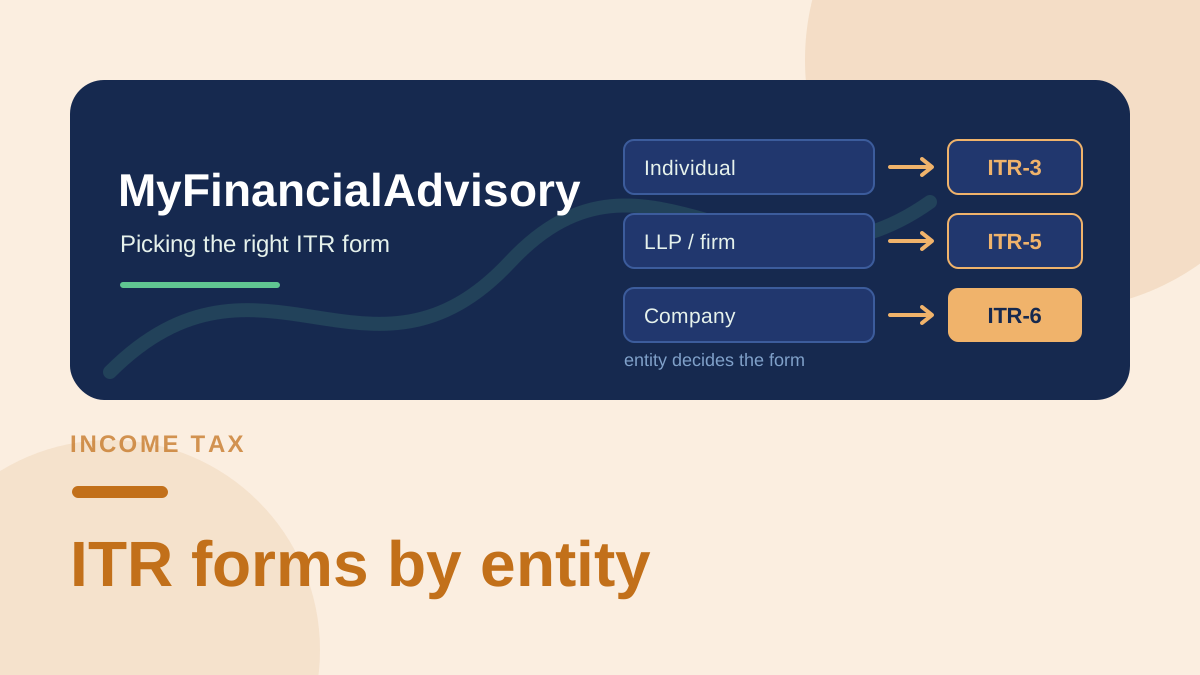
ITR-5 is the form for firms, LLPs and associations of persons, and that numbering is unchanged for assessment year 2026-27. ITR-4 (Sugam) is not available to an LLP — the Department's eligibility page describes it as open to a resident individual, HUF or firm other than an LLP — so the simplified presumptive return is closed as a form matter. For tax year 2026-27 the return obligation moves to section 263 of the 2025 Act; which form number that return carries was not verified, so this page states none, and no notification number was published for the AY 2026-27 forms either.
Filing is annual and unconditional. A quiet year is still a year, and two costs land on exactly the LLP that thought it had nothing to report: the late-return fee of ₹1,000 where total income is ₹5,00,000 or less and ₹5,000 otherwise — section 234F for AY 2026-27, section 428(a) for tax year 2026-27 — and the loss of loss carry-forward, which is what a dormant LLP most needs to keep.
Books of account are a separate and much lower obligation. Section 62 of the 2025 Act requires books where income exceeds ₹1,20,000 or turnover ₹10 lakh in any one of the three preceding years — the relaxed ₹2,50,000 and ₹25 lakh figures are for an individual or HUF only. Our tax audit page covers that obligation in depth.
Audit triggers — two kinds
- Tax audit (income-tax law): above the income-tax turnover thresholds — section 44AB for AY 2026-27, section 63 for tax year 2026-27
- LLP Act audit: LLPs above prescribed turnover or contribution limits need their accounts audited under the LLP Act
These are distinct; one, both or neither may apply. Different statutes, different authorities, different consequences — an LLP can be inside the LLP Act audit and outside the income-tax audit, or the reverse. We assess your LLP.
The LLP Act limb, described honestly
The LLP Act requires audit once an LLP crosses prescribed limits of turnover or of partner contribution. We are not publishing those two figures here. They sit in the LLP Act and its rules, which were not part of the source material verified for this page, and a threshold quoted from memory is exactly the number that gets an LLP to skip an audit it needed. Confirm both limits under the LLP Act. This limb also drives the auditor's signature on Form 8 — see our Form 8 and Form 11 guide and LLP compliance.
The income-tax limb — section 63
For tax year 2026-27 the tests are in section 63(1) of the Income-tax Act, 2025, and the Department confirms the thresholds are the same as under the old Act:
| Test | Threshold | Note |
|---|---|---|
| Business turnover or gross receipts | more than ₹1 crore | the ordinary trigger |
| Business, low-cash relief | raised to more than ₹10 crore | only where cash receipts are 5% or less of receipts and cash payments 5% or less of payments |
| Profession, gross receipts | more than ₹50 lakh | independent of the business test |
| Presumptive income declared below the deemed figure | no turnover threshold at all | s.63(1) Table Sl. No. 2 — a separate trigger |
Both cash tests, not either. The ₹10 crore figure is relief, conditional on two percentages at once. Pass the receipts test, fail the payments test, and you are back on ₹1 crore — the most common way this relief is claimed wrongly.
The report is due before the return. For AY 2026-27 the Department states it is due 30 September 2026, on Forms 3CA or 3CB with Form 3CD. For tax year 2026-27 it is due 30 September 2027, on Form No. 26 under the Income-tax Rules, 2026, which merges the three old forms into one. Section 63(5)(a) drives both: the specified date is one month before the return due date under section 263(1). Missing a required audit costs money on its own — for tax year 2026-27, section 428(c) charges ₹75,000 where the delay is up to one month and ₹1,50,000 thereafter. The equivalent rule for AY 2026-27 sits in the 1961 Act and is not stated here.
Worked example: an LLP that thinks it is under the ₹10 crore line
Assumptions: tax year 2026-27; a trading LLP; no professional receipts; no transfer-pricing report under section 172; no presumptive scheme; turnover ₹4,20,00,000; total receipts ₹4,35,00,000 of which ₹9,00,000 is cash; total payments ₹4,05,00,000 of which ₹28,00,000 is cash.
- Cash receipts = ₹9,00,000 / ₹4,35,00,000 = 2.07% — inside the 5% limb.
- Cash payments = ₹28,00,000 / ₹4,05,00,000 = 6.91% — outside it.
One limb passes, one fails, so the ₹10 crore relief is unavailable. The threshold is ₹1 crore, turnover of ₹4.2 crore is above it, and an income-tax audit applies. Everything downstream moves: report due 30 September 2027, the LLP's return from 31 August to 31 October 2027, and — the part people miss — every partner's own return to 31 October 2027 too, because the partner rows key off whether the firm's accounts require audit.
Now change one number. Bring cash payments to ₹19,00,000, which is 4.69%, and both limbs pass: the threshold becomes ₹10 crore, no audit applies, and the LLP and its partners are back on 31 August 2027. Roughly ₹9 lakh of cash payments moved four filing dates and an audit fee.
Due dates
The Finance Act, 2026 rewrote the due-date table for both Acts — section 5(a) for Explanation 2 to section 139(1) of the 1961 Act, section 66(a) for the equivalent in section 263(1) of the 2025 Act. They produce identical rows.
| Who | Condition | Due date |
|---|---|---|
| Any assessee, including a partner | transfer-pricing report applies (s.92E / s.172) | 30 November |
| A company; any assessee whose accounts require audit; a partner of a firm whose accounts require audit | no transfer pricing | 31 October |
| An assessee with business or profession income not required to be audited; a partner of such a firm | no transfer pricing | 31 August |
| Any other assessee | — | 31 July |
For AY 2026-27 those dates fall in 2026; for tax year 2026-27, in 2027.
Read the table by description, not by entity type. There is no row headed "LLP". The LLP is an assessee with income from business or profession, so it sits on 31 August unless its accounts require audit, which moves it to 31 October, or a transfer-pricing report applies, which moves it to 30 November.
The correction worth flagging. The non-audit business date used to be 31 July. It is now 31 August. Anything still saying "31 July for all non-audit cases" is out of date; the residual 31 July row survives, but only for an assessee with no business or professional income.
MCA Form 11 and Form 8 run on their own clock, with due dates set under the LLP Act; mixing them up with the ITR is a common cause of missed deadlines and penalties. Those dates were not verified here — see the Form 8 and Form 11 guide.
Late, revised and updated returns
| AY 2026-27 (1961 Act) | Tax year 2026-27 (2025 Act) | |
|---|---|---|
| Belated return | s.139(4) — by 31 December 2026, or completion of assessment, whichever is earlier | s.263(4) — 9 months from the end of the tax year |
| Revised return | s.139(5) — before the end of the assessment year, i.e. 31 March 2027, or completion of assessment | s.263(5) — 12 months from the end of the tax year |
| Updated return | s.139(8A) — 48 months from the end of the FY succeeding the tax year | s.263(6) — the same 48 months |
| Fee for a late return | s.234F — ₹1,000 if total income ≤ ₹5 lakh, else ₹5,000 | s.428(a) — the same amounts |
31 December is the belated boundary, not the revised one. Revision for AY 2026-27 runs to 31 March 2027. Because the two no longer coincide, a belated return can now be revised — impossible when they did. Revising after the nine-month point attracts a fee; that is a cost, not a cut-off.
An updated return is the fallback, not a plan: it cannot produce an enhanced loss, decrease total tax liability or increase a refund, only one is allowed per tax year, and additional income-tax is payable on it. See our revised, belated and updated return guide and revised ITR filing.
Verification is part of the deadline
The return must be e-verified, or the ITR-V submitted, within 30 days of filing. Filed on time but verified after 30 days, the date of verification becomes the date of furnishing — so the return is late, with the fee and lost carry-forward that follow. A return never verified is treated as invalid, though condonation can be requested for a genuine delay. Filing on 31 August and verifying on 5 October is not an administrative gap. It is a late return.
Advance tax across the LLP's year
The LLP pays advance tax once its liability reaches ₹10,000 — section 208 of the 1961 Act, section 404 of the 2025 Act, threshold unchanged. The cumulative instalments under section 408 are 15% by 15 June, 45% by 15 September, 75% by 15 December and 100% by 15 March, and advance tax follows the year of the income, not the date of payment: the 15 March 2026 instalment is a 1961-Act payment, the 15 June 2026 one a 2025-Act payment. Interest runs at 1% a month where advance tax is unpaid or below 90% of assessed tax (section 234B, now section 424) and 1% or 3% for deferring an instalment (section 234C, now section 425). Partner remuneration is the figure most often settled only in March, which mis-states the LLP's own deductible expense in every earlier instalment — see our advance tax guide.
Partner returns
Remuneration and interest the LLP pays partners are taxable in the partners' own hands — so the LLP return and the partners' returns must stay aligned. We keep them consistent.
The LLP's audit status sets the partners' due date. Read the table above again: a partner of a firm whose accounts require audit files by 31 October; a partner of a firm not required to be audited files by 31 August. The partner does not get to choose. And no partner can finalise their return until the LLP's numbers are final, so an LLP that drifts past its own date leaves every partner filing late, each with their own fee and lost carry-forward.
The deduction and the income must be the same number. What the LLP claims as remuneration or interest is what the partner reports. Those amounts are deductible for the LLP within the limits the Act and the LLP agreement impose — we do not publish those limits here, because they were not part of what we verified. A deduction beyond what the agreement authorises is the first thing an assessing officer looks for.
Tax deducted at partner level is credited, not lost. Section 396 treats it as income received, so the partner grosses up, and section 401 bars a direct demand for tax already deducted. A partner can also apply under section 395(1) for a lower or nil deduction certificate, in Form No. 128 under Rule 213. Which return form a partner uses depends on the whole of their income, not only the LLP — see our income tax return filing guide.
The obligation most LLPs miss: deduction on payments to a partner
For a payment in tax year 2026-27 the governing provision is section 393(3), Table serial number 7 of the Income-tax Act, 2025 — the successor to section 194T:
| Item | Position |
|---|---|
| Provision | s.393(3), Table Sl. No. 7 (old s.194T) |
| Rate | 10% |
| Threshold | ₹20,000 for the tax year |
| Sub-section to quote | (3), "any person" — not s.393(1), which is payments to a resident, and not s.392, which is salary |
| TAN | required — not on the s.397(1)(c) exemption list |
| Quarterly statement | Form No. 140, Rule 219(1) |
| Certificate to the partner | Form No. 131, Rule 215(1), within 15 days of the statement due date |
Get the sub-section right. The partner row sits in table (3), "any person" — not (1), payments to a resident, and not (2), payments to a non-resident. The Department warns that a wrong provision may cause processing errors at filing and force a correction statement. Our TDS section crosswalk has the full mapping.
A TAN is not optional here. Section 397(1)(c) exempts only a short list from the TAN requirement — rent by a non-specified payer, transfer of immovable property, and contractor or professional payments by a small individual or HUF, with two more added from 1 October 2026. Payments to a partner are not on that list. The LLP applies in Form No. 135 under Rule 216(1) — see TAN registration.
The calendar this creates. Under Rule 218(2) tax is deposited within 7 days from the end of the month of deduction, except for a March credit or payment, where the date is 30 April. Statements follow Rule 219(4):
| Quarter ending | Statement due |
|---|---|
| 30 June | 31 July |
| 30 September | 31 October |
| 31 December | 31 January |
| 31 March | 31 May of the following financial year |
Section 397(3)(f) allows a correction statement for two years from the end of the tax year in which the statement was due. Our TDS return filing guide covers the mechanics, and we file them if you would rather not.
Worked example: a two-partner LLP that pays monthly
Assumptions: tax year 2026-27; two resident partners, each with a valid PAN and no certificate under section 395; the LLP holds a TAN; remuneration of ₹60,000 a month credited to each partner's current account on the last day of each month from April 2026; no interest on capital; and, stated openly, the deduction computed on the whole of the year's partner payments once the ₹20,000 line is passed rather than on the excess — the cautious reading. See "What this page does not claim".
- April 2026. ₹60,000 credited to each partner, so the ₹20,000 aggregate is passed in month one. Deduct 10% — ₹6,000 per partner, ₹12,000 in all. Deposit due 7 May 2026.
- Quarter 1. ₹1,80,000 credited per partner, tax ₹18,000 per partner. The statement in Form No. 140 is due 31 July 2026, and each partner's Form No. 131 follows within 15 days.
- The March credit. Deducted in March, so the deposit date is 30 April 2027, not 7 April, and it falls in the Q4 statement due 31 May 2027.
- Full year. ₹7,20,000 per partner, ₹14,40,000 in total, tax deducted ₹1,44,000.
Each partner picks up ₹72,000 of credit against their own liability, section 396 treats it as income received, and section 401 stops the Department demanding it from them a second time.
Worked example: what it costs to skip it
Assumptions: the same LLP and the same ₹14,40,000 of partner remuneration for tax year 2026-27; nothing deducted at any point; the omission found while preparing the return; the partners resident, and no accountant's certificate under section 398(2) obtained.
| Consequence | Provision | Amount |
|---|---|---|
| Tax that should have been deducted | s.393(3) Sl. No. 7 | ₹1,44,000 |
| Expenditure disallowed — 30% of the sum | s.35(b)(i) | ₹4,32,000 added back to business income |
| Interest | s.398(3)(a) | 1% a month from the date deductible to the date deducted; 1.5% a month from deduction to actual payment |
| Fee for the late quarterly statements | s.427 | ₹200 a day, capped at the tax deductible — here ₹1,44,000 |
| Penalty, statement not filed or filed wrong | s.461(1) | ₹10,000 to ₹1,00,000 |
| No TAN at all | s.468(1) | ₹10,000 |
The disallowance is the expensive line and stays invisible until assessment: ₹4,32,000 of otherwise good expenditure comes back into income because ₹1,44,000 was not deducted. Section 35(b) bites equally where the tax was deducted but not deposited by the return due date — the version that catches organised LLPs rather than careless ones. It is allowed back in the tax year the tax is paid, so it is a timing cost; the interest and fee are not recoverable at all.
Two reliefs are worth knowing. Section 398(2): the LLP is not in default where the partner filed a return, included the amount and paid the tax, on an accountant's certificate in the prescribed form — but interest still runs to the date the partner filed. Section 461(2): the ₹10,000-to-₹1,00,000 penalty is waived where tax, fee and interest were paid and the statement was delivered within one month of the prescribed time. That safe harbour does not waive the ₹200-a-day fee.
Common mistakes
- Assuming a dormant LLP need not file. It must — ITR-5 and the MCA returns both
- Confusing ITR-5 with MCA Form 8/11. Different authorities, different deadlines, and one does not discharge the other
- Remuneration beyond agreement or Act limits. The deduction is only as good as the clause authorising it
- Missing an audit trigger — in particular reading the ₹10 crore relief as available when only one cash test is met
- Still working to 31 July for a non-audit LLP. It is 31 August, and has been since the Finance Act, 2026
- Treating 31 December as the revised-return cut-off. It is the belated boundary; revision for AY 2026-27 runs to 31 March 2027
- Filing on time and verifying late. Past 30 days, the verification date becomes the filing date
- Paying partners without deducting under section 393(3), serial number 7 — including where the amount is only credited to a capital or current account
- Quoting section 393(1) for a partner payment. It is section 393(3); the sub-section is part of the citation
- Applying the 2025 Act to assessment year 2026-27. That year is 1961-Act territory and stays there
What this page does not claim
Naming what we could not verify beats a confident number that turns out to be for a different year.
- No LLP tax rate, alternate minimum tax rate or surcharge figure. None was verified, so none is published. Confirm all three for the year before you compute anything.
- No LLP Act audit thresholds, and no MCA Form 8 or Form 11 due dates — LLP Act obligations, and they belong on a page that verified them.
- No partner remuneration or interest deduction limits, and no form number for the LLP's return for tax year 2026-27 or notification number for the AY 2026-27 forms.
- Whether the ₹20,000 threshold in section 393(3), serial number 7 charges the whole amount or only the excess. Section 393(1)(a) charges the entire amount once a threshold is crossed for the section 393(1) rows; the equivalent wording for section 393(3) was not verified, and the worked example takes the cautious reading. The same caution applies to that row's trigger clause — the Act's general test is the earlier of credit or payment, and for an LLP what matters is that a credit to a partner's account is an event even when no cash moves.
- Whether an LLP can use the presumptive scheme at all. Declaring below the deemed figure is an audit trigger, and ITR-4 (Sugam) is in terms unavailable to an LLP. Whether an LLP is an eligible assessee for the scheme itself our sources do not settle.
- No quotation from the Income-tax Act, 1961. Its text was not captured, so where this page names a 1961-Act section it is naming it, not quoting it.
Where to go next
Unsure whether an audit applies? Start with tax audit applicability, then tax audit support. If the MCA side is overdue, use the Form 8 and Form 11 guide and LLP compliance. To compare an LLP with a company, read the company ITR guide and the company compliance checklist; a firm's position is on partnership firm ITR filing.
If the partner-payment deduction was news, deal with it before the next quarter closes — TAN registration first, then ITR-5 filing with the partner ledger reconciled.
Sources and currency
Applies to: India. Assessment year 2026-27 — income of FY 2025-26 — is governed by the Income-tax Act, 1961, including for proceedings begun after 1 April 2026. Tax year 2026-27 — income of FY 2026-27 — is governed by the Income-tax Act, 2025, which commenced on 1 April 2026 under its section 1(3). Both are open at once and this page answers each separately.
Every date, threshold, rate, form number and section reference here was read from the Gazette of India text of the Income-tax Act, 2025, the Finance Act, 2026 and the Income-tax Rules, 2026, and checked against the Income Tax Department's e-filing guidance, on 19 and 20 August 2026. This page publishes no LLP tax rate, alternate minimum tax rate, surcharge figure or LLP Act audit threshold, because none was verified in that pass — where a figure is missing it is said so, not quietly dropped. Income-tax provisions change at each Finance Act; confirm the current position before relying on a figure for a filing.
- Income-tax Act, 2025 (No. 30 of 2025) — Gazette of India Extraordinary, 21 August 2025 (s.1(3), s.35(b), s.62, s.63, s.263, s.393 to s.401, s.536)
- Finance Act, 2026 (No. 4 of 2026) — Gazette of India Extraordinary, 30 March 2026 (s.5 and s.66 due dates, s.96 substituting s.427 and s.428)
- Income-tax Rules, 2026 — G.S.R. 198(E) dated 20 March 2026 (Rules 215, 216, 218 and 219)
- Income Tax Department, e-filing portal — Income Tax Returns
- Income Tax Department, e-filing portal — Income Tax Forms
- Income Tax Department, e-filing portal — Tax Payments
- Income Tax Department, e-filing portal — ITR-V and the 30-day e-verification timeline
Frequently asked questions
Which ITR does an LLP file?
ITR-5, every year, regardless of turnover or profit. ITR-5 is the form for firms, LLPs and associations of persons. The LLP is a separate taxpayer and is assessed separately from its partners, at the rate applicable to an LLP for the year — we do not publish that rate here because it was not part of what we verified, so confirm it for the year you are filing. Note also that ITR-4 (Sugam) is expressly not available to an LLP, so the simplified presumptive return is not an option even if the numbers would otherwise fit.
Does a dormant LLP need to file ITR?
Yes. Even with no activity, an LLP files ITR-5 and its MCA returns. A quiet year does not switch the obligation off, and there are two practical costs to skipping it: the late-filing fee of ₹1,000 where total income is ₹5,00,000 or less and ₹5,000 otherwise, and the loss of the right to carry forward losses, which is exactly what a dormant LLP is most likely to have.
What is the difference between ITR-5 and Form 8/11?
ITR-5 is the income tax return filed with the Income Tax Department. Form 11 (annual return) and Form 8 (statement of account and solvency) go to the MCA under the LLP Act. All are annual and all are mandatory, and they run on separate deadlines set by separate authorities. Filing one does not discharge the other, and the most common LLP compliance failure is assuming it does.
When does an LLP need an audit?
There are two independent audits and either can apply on its own. An income-tax audit applies where business turnover exceeds ₹1 crore — raised to ₹10 crore only where cash receipts are 5% or less of receipts and cash payments are 5% or less of payments, both tests together — or where professional gross receipts exceed ₹50 lakh, or where presumptive income is declared below the deemed figure. Separately, the LLP Act requires audit above prescribed limits of its own, which must be confirmed under that Act. One, both or neither may apply.
When is an LLP ITR due?
For assessment year 2026-27 the return is due 31 August 2026 where no tax audit is required, 31 October 2026 where one is, and 30 November 2026 where a transfer-pricing report under section 92E applies. Tax year 2026-27 carries the same three dates in 2027. Note the correction: 31 August, not 31 July, is now the non-audit date for a business or profession, following the Finance Act, 2026. MCA Form 8 and Form 11 have their own due dates under the LLP Act.
How is partner remuneration treated?
Remuneration and interest are deductible for the LLP within the limits the Act and the LLP agreement impose, and taxable in the partners' hands, so the LLP return and the partner returns must stay aligned. We do not publish those deduction limits here — they were not part of what we verified — so confirm them for the year. What is new and often missed is that the payment now also carries a deduction at source of 10% once the aggregate for the tax year passes ₹20,000.
Does an LLP have to deduct TDS on payments to its partners?
For a payment in tax year 2026-27 the provision is section 393(3), Table serial number 7 of the Income-tax Act, 2025 — the old section 194T — at 10%, with a threshold of ₹20,000 for the tax year. That obligation is not on the list of deductions exempted from holding a TAN under section 397(1)(c), so the LLP needs a TAN and files quarterly statements in Form No. 140 under Rule 219 of the Income-tax Rules, 2026, issuing the partner a certificate in Form No. 131.
What happens if the LLP does not deduct TDS on partner payments?
Four things stack. Section 35(b)(i) disallows 30% of the sum in computing business income, allowed back in the tax year the tax is paid. Section 398(3)(a) charges interest at 1% a month from the date the tax was deductible to the date it was deducted, and 1.5% a month from deduction to actual payment. Section 427 charges ₹200 a day for a late statement, capped at the tax deductible. Section 461 adds a penalty of ₹10,000 to ₹1,00,000, avoidable only within a one-month safe harbour.
Which Act governs my LLP's return this year?
It depends entirely on which year's income you are reporting. Assessment year 2026-27 covers income of FY 2025-26 and is governed by the Income-tax Act, 1961, and stays so even for proceedings begun after 1 April 2026, under section 536(2)(c) of the new Act. Tax year 2026-27 covers income of FY 2026-27 and is governed by the Income-tax Act, 2025, which commenced on 1 April 2026 under section 1(3). Both are live obligations at the same time and each has its own due date.
Related MFA services
If you want this handled rather than done yourself, these are the matching services.
Written by
MyFinancialAdvisory Editorial
Editorial guidance prepared for business owners and reviewed before production publication.
Reviewed by MyFinancialAdvisory Tax Team
Written against official sources, with the governing rule named wherever a figure or deadline is given. General guidance — not advice on your specific case.
Ready to act?
ITR-5 filed, with the partner ledger checked first
The LLP return prepared against the books, the audit question settled before the due date moves, and the partner-payment deduction reconciled so it does not come back as a disallowance.
Related guides

Income Tax
Tax Audit Applicability: When Section 44AB Applies
Whether a tax audit applies to you, answered for both years that are open at once — section 44AB for AY 2026-27 and section 63 for tax year 2026-27 — with the turnover tests, the presumptive trap, the books-of-account obligation that bites far lower, and what a late report now costs.
Read guide
MCA Compliance
LLP Annual Compliance: Form 8, Form 11 and What Being Late Costs
An LLP files two MCA forms a year, and being late costs two separate things that almost every summary merges into one wrong number. The additional fee is a multiple, the penalty is per day and capped, and ₹100 a day has not been the filing rate since April 2022.
Read guideIncome Tax
Company ITR Filing Guide: ITR-6, Tax Audit & Due Dates
A company's income-tax year end, start to finish — which return form, what feeds it, when the tax audit report is due, the 31 October date and the transfer-pricing exception, the company's own obligations as a deductor, and what a late return costs. Answered separately for assessment year 2026-27 and tax year 2026-27, because both are open at once.
Read guide