
Proprietorship vs Private Limited Company: Which Should You Choose?
Start simple as a proprietor, or incorporate a Private Limited Company? The right choice depends on liability, funding and growth plans. Here is a clear, honest comparison.
On this page
Every new founder faces this fork: keep it simple as a sole proprietor, or set up a Private Limited Company. Both are valid — the right answer depends on your plans.
Quick answer
Choose a proprietorship if you want the cheapest, fastest start and are comfortable with unlimited personal liability and no equity funding. Choose a Private Limited Company if you want limited liability, credibility, and the ability to raise funding and issue ESOPs — at the cost of more compliance.
Head-to-head
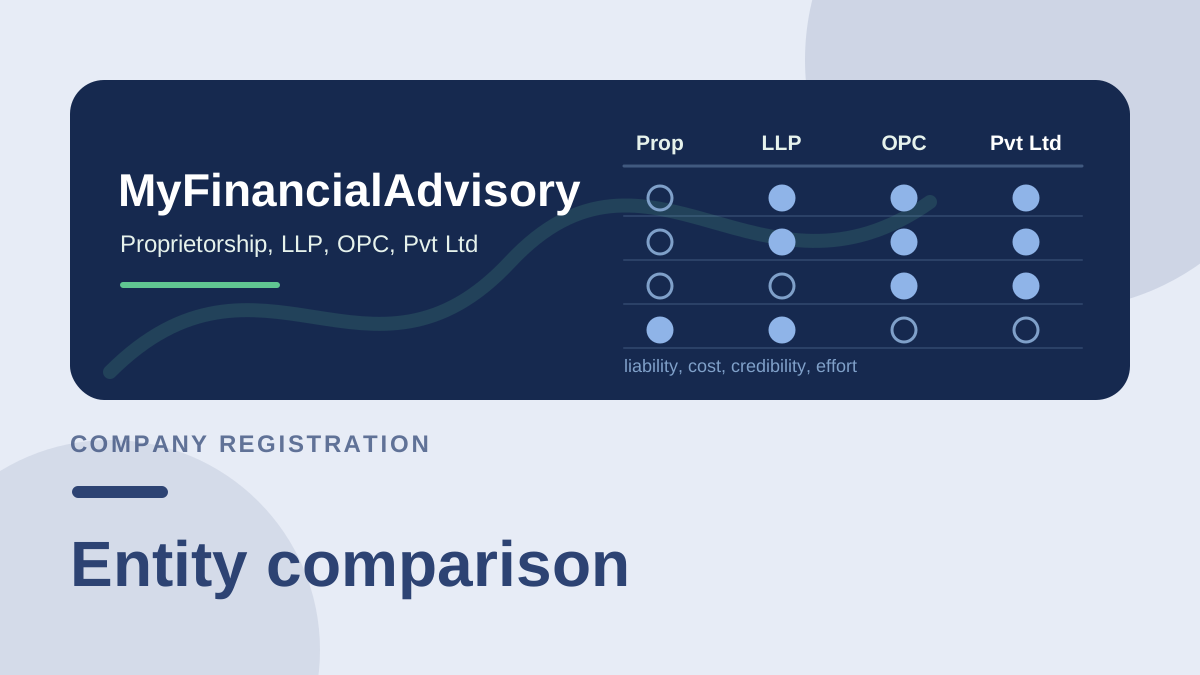
| Factor | Proprietorship | Private Limited Company |
|---|---|---|
| Liability | Unlimited (personal assets at risk) | Limited to shares |
| Legal identity | Same as the owner | Separate legal entity |
| Setup cost & speed | Lowest, fastest | Higher, ~7–10 days |
| Funding & ESOPs | Not possible | Investor- and ESOP-friendly |
| Compliance | Minimal | Annual MCA filings, audit |
| Credibility | Lower | Higher (CIN, company) |
When a proprietorship makes sense
You're testing an idea, freelancing, or running a small local business with limited risk and no plan to raise capital. It's cheap, quick and easy to wind down.
When to choose a Private Limited Company
You're building a startup, plan to raise funding, want to protect personal assets, issue ESOPs, or simply need the credibility a registered company brings.
A middle path
If you want limited liability but have a single founder and no immediate funding plans, an OPC or LLP can be a sensible middle ground.
Common mistakes
- Staying a proprietor as risk and revenue grow
- Incorporating a company before you need the structure (and its compliance)
- Choosing on cost alone, ignoring liability
There's no universally right answer — only the right answer for your stage and plans.
Ready to act?
Not sure which structure fits?
Tell us your plans and we'll recommend the right structure — proprietorship, OPC, LLP or Private Limited — and set it up.
Frequently asked questions
Should I start as a proprietorship or a Private Limited Company?
Choose a proprietorship for the cheapest, fastest start with minimal compliance if you accept unlimited liability and no equity funding. Choose a Pvt Ltd for limited liability, credibility and the ability to raise funding.
What is the main risk of a proprietorship?
Unlimited personal liability — you and the business are legally the same, so your personal assets are at risk for business debts.
Can a proprietorship raise funding?
No. Equity investors require a company structure. A proprietorship can't issue shares or ESOPs.
Is a Private Limited Company hard to maintain?
It has more compliance — annual MCA filings, audit and director KYC — but it's manageable with the right support and is expected by investors.
Can I convert a proprietorship to a company later?
Yes. Many founders start as proprietors and incorporate as they grow. We can handle the transition.
What if I'm a solo founder who wants limited liability?
Consider an OPC (One Person Company) or an LLP as a middle path — limited liability without a co-founder, and lighter compliance than a Pvt Ltd in the LLP's case.
Related MFA services
If you want this handled rather than done yourself, these are the matching services.
Written by
MyFinancialAdvisory Editorial
Editorial guidance prepared for business owners and reviewed before production publication.
Reviewed by MyFinancialAdvisory Compliance Team
Written against official sources, with the governing rule named wherever a figure or deadline is given. General guidance — not advice on your specific case.
Ready to act?
Not sure which structure fits?
Tell us your plans and we'll recommend the right structure — proprietorship, OPC, LLP or Private Limited — and set it up.
Related guides
Company Registration
Private Limited Company vs LLP
Private limited company or LLP? A practical comparison across liability, compliance burden, taxation, raising investment and cost — so you pick the structure that fits your plan.
Read guide
Company Registration
OPC Registration Process in India: A Solo Founder's Guide
A One Person Company lets a single founder run a company with limited liability. Here is the full OPC registration process, the nominee requirement, and how it differs from a proprietorship.
Read guide
Company Registration
Private Limited Company Registration Process in India
The full SPICe+ route, form by form — name reservation, Part B, eMoA/eAoA, AGILE-PRO-S, the government fees that actually apply, why applications get sent back, and every post-incorporation deadline with the section behind it.
Read guide